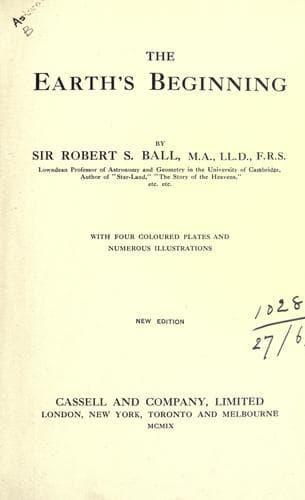
The Earth's BeginningBall, Robert S. (Robert Stawell)
Science
The Earth's Beginning
Ball, Robert S. (Robert Stawell)
Krakatoa (Indonesia); Nebular hypothesis
We know, of course, that this earth, no matter how various may be the
rocks and minerals which form its crust, and how infinite the variety of
objects, organic and inorganic, which diversify its surface, is really
formed from different combinations of about eighty different elements.
There are gases like oxygen and hydrogen, there are other substances
like carbon and sulphur, and there are metals like iron and copper.
These elements are sometimes met with in their free or uncombined state,
like oxygen in the atmosphere, or like gold in Klondike. More frequently
they are found in combination, and in such combinations the characters
of the constituent elements are sometimes completely transformed. A
deadly gas and a curious metal, which burns as it floats on water, most
certainly renounce their special characters when they unite to form the
salt on our breakfast-table. Who would have guessed, if the chemist had
not told him, that in every wheelbarrowful of ordinary earth there are
pounds of silvery aluminium, and that marble is largely composed of an
extremely rare metal, which but few people have ever seen?
Until the middle of the century just completed it seemed utterly
impossible to form any notion as to the substances actually present in
the sun. How could anyone possibly discern them by the resources of the
older chemists? It might well have been doubted whether the elements of
which the sun was made were the elements of which our earth was formed,
and with which ordinary chemistry had made us familiar. Just as the
animals and plants which met the gaze of the discoverers when they
landed in the New World were essentially different from those in the Old
World, so it might have been supposed, with good share of reason, that
this great solar orb, ninety-three million miles distant, would be
composed of elements totally different from those with which dwellers on
the earth had been permitted to become acquainted.
This great discovery of the last century revealed to us the character of
the elements which constitute the sun. It also added the astonishing
information that they are essentially the same elements as those of
which our earth itself and all which it contains are formed.
If any one had asked in the early years of the century what those
elements were which entered into the composition of the sun, the
question would have been deemed a silly one; it would have been regarded
as hopelessly beyond the possibility of solution, and it would have been
as little likely to receive an answer as the questions people sometimes
ask now as to the possible inhabitants on Mars.
Public-domain text, read in full here on John Shaqi.
Reviews
Reviews
No reviews yet
Be the first to share your thoughts on this work.
Elsewhere in the archive
Join the Discussion
Join the discussion
Sign in to leave a comment or review.
Sign InorCreate an account