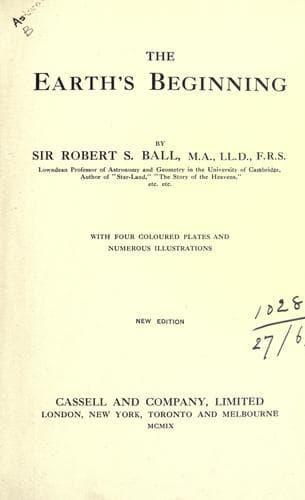
The Earth's BeginningBall, Robert S. (Robert Stawell)
Science
The Earth's Beginning
Ball, Robert S. (Robert Stawell)
Krakatoa (Indonesia); Nebular hypothesis
But about the middle of the century a new era dawned; the wonderful
method of spectroscopic analysis was discovered, and it became possible
to examine the chemistry of the sun. The most important result was to
show that the elements which enter into the composition of the sun are
the same elements which enter into the composition of the earth. The
student of the solar chemistry enjoys, however, one advantage over the
terrestrial chemist, if it be an advantage to have his science
simplified to the utmost extent. Chemistry would, however, lose its
chief interest if all the elements remained as obstinately neutral as
argon, and disdained alliance with all other elements. It would seem
that those elements which most eagerly enter into combination here, and
which resist with such vehemence our efforts to divorce them, must
renounce all chemical union when exposed to the tremendous temperature
of the sun.
Those elements which unite with the utmost eagerness at ordinary
temperatures, seem to become indifferent to each other when subjected to
the extremes of heat and cold. Potassium unites fiercely with oxygen in
the most familiar of all chemical experiments. Potassium is indeed a
strange metal, for it is of such small density that a piece cast on a
basin of water will float like a chip of wood. It has such avidity for
oxygen that it will decompose the water to wrench the molecules of
oxygen from those of hydrogen. The union of the metal with the gas
generates such heat that the strange substance bursts into flame. This
is what takes place at the ordinary temperatures in the well-known
experiment of the chemical lecture-table. But at extreme temperatures
the greed of potassium for oxygen abates, if it does not vanish
altogether. In those excessively low temperatures at which Professor
Dewar experiments chemical affinities languish. He has reduced oxygen to
a liquid, and he tells us that “a berg of silvery potassium might float
for ever untarnished on an ocean of liquid oxygen.” At the excessively
high temperature of the electric arc the oxygen and the potassium, whose
union has been accomplished with such vehemence, cease to possess
affinity, and they separate again.
The solar chemistry seems to know no combination. If a drop of water
were transferred to the sun and subjected to the heat of the solar
surface, it must immediately undergo decomposition. That which was a
drop of water here would not remain a drop of water there; it would be
at once resolved into its component elements of oxygen and hydrogen. The
considerations just given greatly simplify the search for the particular
bodies which are at present in the sun. We have only to test for the
presence of each of eighty elements. We have not to take account of the
thousands of chemical combinations of which these elements are
susceptible under terrestrial conditions.
Public-domain text, read in full here on John Shaqi.
Reviews
Reviews
No reviews yet
Be the first to share your thoughts on this work.
Elsewhere in the archive
Join the Discussion
Join the discussion
Sign in to leave a comment or review.
Sign InorCreate an account