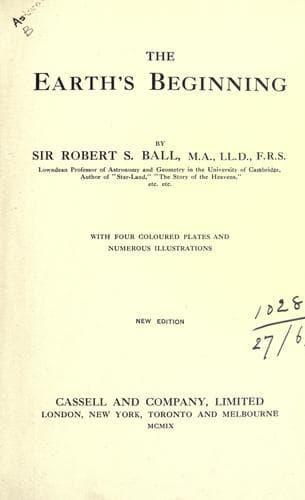
The Earth's BeginningBall, Robert S. (Robert Stawell)
Science
The Earth's Beginning
Ball, Robert S. (Robert Stawell)
Krakatoa (Indonesia); Nebular hypothesis
We are not by any means
claiming that such collisions occur frequently. But what we do say is,
that if, as we believe, these bodies are to be reckoned in many millions
of millions, then it does sometimes happen that two of them, moving
about in space, will approach together sufficiently to give rise to a
collision. It was from some such collision that we believe the nebula
took its rise from which the solar system originated.
We have the best reason for knowing that celestial collisions do
sometimes occur. It will be in the recollection of the readers of this
chapter that in February, 1901, the astronomical world was startled by
the announcement of the outbreak of a new star in Perseus. A photograph
of that part of the heavens had been taken a few days before. There were
the ordinary stars, such as existed from time immemorial, and such as
have been represented on the numerous maps in which the stars are
faithfully set down. But, on February 22nd, Dr. Anderson, already famous
by similar discoveries, noticed that the constellation of Perseus
contained a star which he had not seen before. Instantly the
astronomical world was apprised by telegraph that a new star had
appeared in Perseus, and forthwith most diligent attention was paid to
its observation. Photographs then obtained show the stars that had been
seen there before, with the addition of the new star that had suddenly
come into view. For a few nights after its discovery the object
increased in lustre, until it attained a brightness as great as that of
Capella or Vega. But in this state it did not long remain. This
brilliant object began to wane. Presently it could not be classed as a
star of the first magnitude, nor yet of the second, and then it ran down
until a little below the third, and even below the fourth. In the
subsequent decline of the star there were several curious oscillations.
On one night the star might be seen, the next night it would be hardly
discerned, while the night after it had again risen considerably. But,
notwithstanding such temporary rallies, the brightness, on the whole,
declined, until at last the star dwindled to the dimensions of a small
point of light, scarcely distinguishable with the naked eye. The decline
was apparently not so rapid as the increase, but nevertheless from the
first moment of its appearance to the last was not longer than a few
weeks.
Public-domain text, read in full here on John Shaqi.
Reviews
Reviews
No reviews yet
Be the first to share your thoughts on this work.
Elsewhere in the archive
Join the Discussion
Join the discussion
Sign in to leave a comment or review.
Sign InorCreate an account