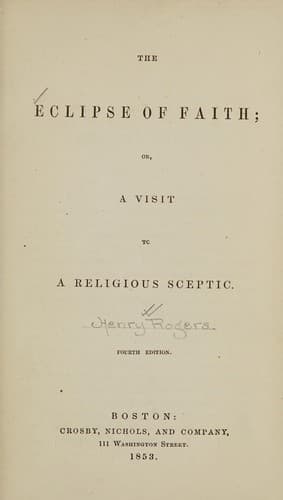
The Eclipse of Faith; Or, A Visit to a Religious ScepticRogers, Henry
Religion
The Eclipse of Faith; Or, A Visit to a Religious Sceptic
Rogers, Henry
Skepticism -- Controversial literature
Produced by Michael John Madden
THE ECLIPSE OF FAITH;
OR
A VISIT TO A RELIGIOUS SCEPTIC.
FIFTH EDITION.
BOSTON: CROSBY, NICHOLS AND COMPANY,
111 WASHINGTON STREET.
1854.
AMERICAN PREFACE.
The effect of the perusal of this book, and the estimate put
upon it by a reader, will depend upon his taking with him a
right view of its design. That design seems in the mind of
the writer to have been very definite and very restricted. If
he should be thought to have intended an answer to all the
elaborate objections from criticism and philosophy recently or
renewedly urged against faith in the Christian revelation,
and, still more, if the reader should suppose that the author
had aimed to remove all the difficulties in the way of
such a faith, he would equally insure his own disappointment,
and wrong the writer. The book comes forth anonymously, but it
is ascribed to Mr. Henry Rogers, some of whose very able
papers in the Edinburgh Review have been republished in two
octavo volumes in England, and one of whose articles, that on
"Reason and Faith," dealt with some of the topics which form
the subject-matter of this volume.
The author seems to have viewed with a keenly attentive and
anxious mind the generally unsettled state of opinion, equally
among the literary and some of the humbler classes in England,
concerning the terms and the sanction of a religious faith,
especially as the issue bears upon the contents and the
authority of the Bible. That he understands the state of things
in which he proposes himself as one who has a word to utter,
will be allowed by all candid judges, whatever criticism they
may pass upon the effectiveness of his own argument. There is
abundant evidence in this book of his large intimacy with
the freshest forms of speculation, as developed by the free
thought of our age. While he identifies these speculations with
the recent writers who have adopted them, he is not to be
understood as allowing that these writers have originated
any novel speculations, or excelled the sceptics of former
times in acuteness, or plausibility, or success in urging their
cause. He adopts the method of the Platonic dialogue, and
exhibits a dialectic skill in confounding by objections when
objections can be made to do service as arguments. His frank
admission that he leaves insurmountable objections and
unfathomable mysteries still involved in the theme, a portion
of whose range alone he traverses, should secure him from the
imputation of having attempted too much, or of boastfulness for
what he considers that he has accomplished.
The truculent notice of this book in the Westminster Review
for July is wholly unworthy of the reputation and the claims
of that journal. Probably a careful perusal of the book is an
essential condition for enlightening the mind of the writer,
and for rectifying his judgment, so far as information has
power to promote candor.
Public-domain text, read in full here on John Shaqi.
Reviews
Reviews
No reviews yet
Be the first to share your thoughts on this work.
Join the Discussion
Join the discussion
Sign in to leave a comment or review.
Sign InorCreate an account