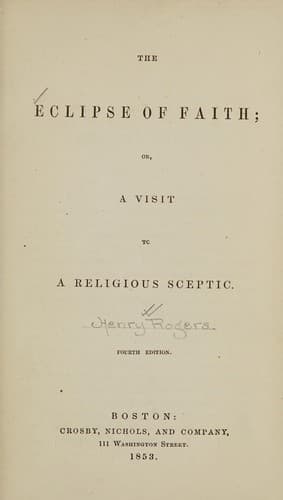
The Eclipse of Faith; Or, A Visit to a Religious ScepticRogers, Henry
Religion
The Eclipse of Faith; Or, A Visit to a Religious Sceptic
Rogers, Henry
Skepticism -- Controversial literature
This frank acknowledgment was followed by some highly curious
conversation, of which I regret my inability to recall all the
particulars. Suffice it to say, that there were not two who were
agreed either as to the grounds on which Christianity was deemed a
thing of naught, or on what was to be substituted in its place; one
even had his doubts whether any thing need be substituted, and
another thought that any thing might be. One of the Rationalists was
a little offended at being supposed willing to "abandon" the Bible
at all: he declared, on the contrary, his unfeigned reverence for
the New Testament at least, as containing, in larger mass and purer
ore than any other book in the world, the principles of ethical truth;
that he was willing even to admit--with exquisite naivete--that it
was inspired in the same sense in which Plato's Dialogues and the Koran
were inspired; he merely dispensed with all that was supernatural and
miraculous and mystical! The Deist laughed, and told him that he
believed just as much, if that constituted a Christian. "I believe,"
said he, "that the New Testament is quite as much inspired as the
Koran of Mahomet; and that it contains more of ethical truth (however
it came there) than is to be found in any other book of equal bulk.
But," he proceeded, "if you dispense with all that is miraculous in
the facts, and all that is peculiar and characteristic in the
doctrines,--that is, all which discriminates Christianity from any
other religion,--I am afraid that your Christianity is own born
brother to my Infidelity. As for your reverence for this inspired
book, since you must reject ninety per cent. of the whole, it seems
to me very gratuitous; equally so, whether you suppose the compilers
believed or disbelieved the facts and doctrines you reject; if the
former, and they were deceived, they must have been inspired
idiots; if the latter, and were deceiving others, they were surely
inspired knaves. For my part," he continued, "while I hold that the
book somehow does unaccountably contain more of the morally true
and beautiful than any book of equal extent, I also hold that
Christianity itself is a pure imposture from beginning to end."
Public-domain text, read in full here on John Shaqi.
Reviews
Reviews
No reviews yet
Be the first to share your thoughts on this work.
Elsewhere in the archive
Join the Discussion
Join the discussion
Sign in to leave a comment or review.
Sign InorCreate an account