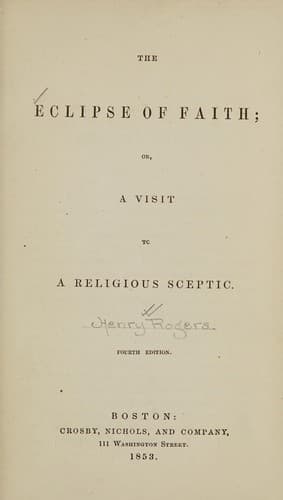
The Eclipse of Faith; Or, A Visit to a Religious ScepticRogers, Henry
Religion
The Eclipse of Faith; Or, A Visit to a Religious Sceptic
Rogers, Henry
Skepticism -- Controversial literature
This coarse avowal of adherence to the elder, and, after all, more
intelligible deism, brought down upon him at once two of the company.
One was the disciple of Strauss (I mean as regards his theory of the
origin of Christianity, not as regards his Pantheism); the other a
Rationalist, with about the same small tatters of Christianity
fluttering about him, but who was a little disposed, like so many
German theologians, to consider Strauss as somewhat passe. Unhappily,
got athwart each other's bows shortly after they into action. They
both enlarged--really in a edifying manner, I could have listened
to them an hour--on the absurdity of the Deist's argument! "What!"
cried one; "the purest system of ethics from the most shameless
impostors!" "And what do you make of the infinitely varied and
inimitable marks of simplicity and honesty in the writers?" cried
the other. "And who does not see the impossibility of getting up the
miracles so as to impose upon a world of bitter and prejudiced enemies
in open day?" exclaimed the Rationalist. "They were obviously mere
myths," cried the Straussian. "That I must beg to doubt," said the
other. And now, as they proceeded to give each his own solution of
the difficulty, the scene became comic in the extreme. The Rationalist
ridiculed the notion that nations and races, all of whom, in the nature
of things, must have been prejudiced against such myths as those of
Christianity, could originate or would believe them; and still more,
the notion that in so short a space of time these wildest of wild
legends (if legends at all) could induce the world to acquiesce
in them as historic realities! In his zeal he even said, that,
though not altogether satisfied with it, he would sooner believe
all the frigid glosses by which the school of Paulus had endeavored
to resolve the miracles into misunderstood "natural phenomena." As
the dispute became more animated between these three champions, they
exhibited a delicate trait of human nature, which I saw our sceptical
host most maliciously enjoyed. Each became more anxious to prove that
his mode of proving Christianity false was the true mode, than to
prove the falsehood of Christianity itself. "I tell you what," said
the Straussian, with some warmth, "sooner than believe all the
absurdities of such an hypothesis as that of Paulus, I could believe
Christianity to be what it professes to be." "I may say the same of
that of Strauss," said the other, with equal asperity; "if I had no
better escape than his, I could say to him, as Agippa to Paul, 'Almost
thou persuadest me to be a Christian.'" "For my part," exclaimed the
Deist, who was perfectly contented with his brief solution,--the
difficulties of the problem he had never had the patience to master,
--"I should rather say, as Festus to Paul, 'Much learning has made
you both mad': and sooner than believe the impossibilities of the
theory of either,--sooner than suppose men honestly and guilelessly
Public-domain text, read in full here on John Shaqi.
Reviews
Reviews
No reviews yet
Be the first to share your thoughts on this work.
Elsewhere in the archive
Join the Discussion
Join the discussion
Sign in to leave a comment or review.
Sign InorCreate an account