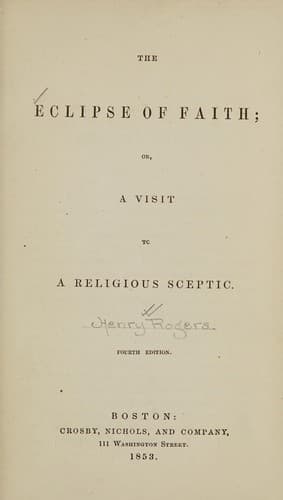
The Eclipse of Faith; Or, A Visit to a Religious ScepticRogers, Henry
Religion
The Eclipse of Faith; Or, A Visit to a Religious Sceptic
Rogers, Henry
Skepticism -- Controversial literature
"Which laws," said his next neighbor, "often secure no reward or
punishment at all,--or rather, often give the reward to the vice of
man, and the punishment to his virtue." "Very true," rejoined the
Deist, "and I must say,"--sagely shaking his head,--"that such
things make me often suspect the whole of that slippery, uncertain
thing called 'natural religion,' whether as taught by the elder
deists or modified by our modern spiritualists. Surely they may be
abundantly charged with the same faults with which they tax the
Christian; for they are full of interminable disputes about the
'truths' or 'sentiments' of their theology."
One of those who had gone further than our Deists felt disposed to
question all "immutable morality" original "dictates of conscience."
"I doubt," said he, "whether those dictates are any clearer than
those dogmas of 'natural religion' which have been so oppugned; and
I judge so for the same reason,--the endless disputes of men with
regard to the source, the rule, the obligation of what they call
duty; which are exactly similar to the disputes which we charge upon
the Natural Religionist and the Christian." And here he ran through
half a dozen of the two score theories which the history of ethics
presents, rare work with Plato and Aristotle, Hobbes, Cudworth,
Mandeville, and Bentham. "Meantime," he concluded, "we do see, in
point of fact, that the moral rule is most flexible, and to an
indeterminate degree the creature of association, custom, and
education, so that I am inclined to think that that alone is
obligatory which the positive laws and institutions of any society
render binding." "So that" cried Harrington, "a man both may and
ought to thieve in ancient Sparta, may expose his parents in
Hindostan, and commit infanticide in China!" "It is a pity," archly
whispered the Italian guest, "that this gentleman was not born
in China."
"It is a respectable, but very old speculation," said Harrington,
"of which many ancient moralists avowed themselves the advocates,
but of which it is only fair to admit that Plato and many other
heathens were heartily ashamed."
Public-domain text, read in full here on John Shaqi.
Reviews
Reviews
No reviews yet
Be the first to share your thoughts on this work.
Elsewhere in the archive
Join the Discussion
Join the discussion
Sign in to leave a comment or review.
Sign InorCreate an account