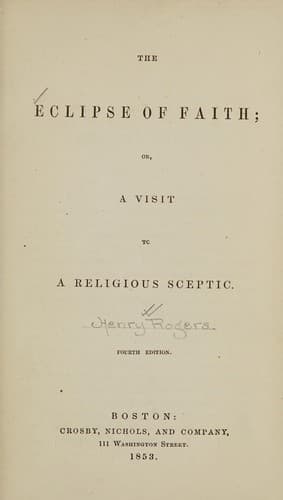
The Eclipse of Faith; Or, A Visit to a Religious ScepticRogers, Henry
Religion
The Eclipse of Faith; Or, A Visit to a Religious Sceptic
Rogers, Henry
Skepticism -- Controversial literature
It seemed as if the bathos of theological and ethical absurdity could
not lie deeper; but I was mistaken. The admirer of Mr. Atkinson
declared with great modesty that he thought, as did his favorite
author, that the whole world had been mad on the subject of theology
and morality;--that the prime error consisted in the superficial
notion of a Personal Deity, and the foolish attribution of the notion
of "sin" and "crime" to human motives and conduct, instead of regarding
the former as a name of an absolutely unknown cause of the entire
phenomena of the universe, and the latter as part of a series of
rigidly necessary antecedents and consequents, for which man is no
more to be either blamed or praised than the sun for shining or the
avalanche for falling; he added, that only in this way could
man attain peace. "As Mr. Atkinson beautifully says, 'What a hopeful
and calming influence has such a contemplation of nature! At this moment
it is not I, but the nature within me, that dictates my speech and
guides my pen. I am what I am. I cannot alter my will, or be other
than what I am, and cannot deserve either reward or punishment.' But
I feel with him, 'We may preach these things, and men may think us
mad or something worse.'" (Pp. 190, 191.)
"And perhaps justly," said Harrington, with a laugh, "for nature has
surely, after so many thousands of years, let you know what her law
is, and you say that that law is necessary and irreversible, and yet
you strive to alter it! You had better leave men to their
necessary absurdities."
"Nay," said the other, "as Mr. Atkinson says, from the recognition of
a universal law we shall develop a universal love; the disposition and
ability to love without offence or ill-feeling towards any; or, as
Miss Martineau represents it,--When the mind has completely surmounted
every idea of a personal God, of a supreme will, 'what repose begins
to pervade the mind! What clearness of moral purpose naturally ensues!
and what healthful activity of the moral faculties!' (p. 219) .... What
a new perception we obtain of the "beauty of holiness,"--the loveliness
of a healthful moral condition,--accordant with the laws of natures,
and not with the requisitions of theology!'" (p. 219.)
I got him afterwards to show me these passages, for I could hardly
believe that he had quoted them right.
"And as for morality," continued he, "the knowledge which mesmerism
gives of the influence of body on body, and consequently of mind on
mind, will bring about a morality we have not yet dreamed of. And who
shall disguise his nature and his acts when we cannot be sure at any
moment that we are free from the clairvoyant eye of some one who is
observing our actions and most secret thoughts; and our whole
character and history may be read off at any moment!" (H. G. A. to
H. M., p. 280.)
Public-domain text, read in full here on John Shaqi.
Reviews
Reviews
No reviews yet
Be the first to share your thoughts on this work.
Elsewhere in the archive
Join the Discussion
Join the discussion
Sign in to leave a comment or review.
Sign InorCreate an account