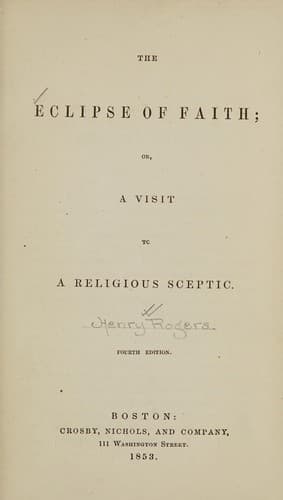
The Eclipse of Faith; Or, A Visit to a Religious ScepticRogers, Henry
Religion
The Eclipse of Faith; Or, A Visit to a Religious Sceptic
Rogers, Henry
Skepticism -- Controversial literature
If the New Testament be supposed a series of fictions, I argued,--the
work of highly imaginative minds for a pious purposes--there is perhaps
a slight moral anomaly in the case (but I do not insist upon it): I mean
that of supposing pious men writing fictions which they evidently wish to
impose on the world as simple history, and which they must have known
would, if received at all, be actually regarded as such; as, in fact,
they have been. I do not quite understand how pious men should thus
endeavor to cheat men into virtue, nor inculcate sanctity and truth
through the medium of deliberate fraud and falsehood. But let that pass;
perhaps one could forgive it. Other anomalies, far more inexplicable,
strike me. That Galilean Jews (such as the history of the time represents
them), with all their national and inveterate prejudices,--wedded not
more to the law of Moses than to their own corruptions of it, bigoted
and exclusive beyond all the nations that ever existed, eaten up with
the most beggarly superstitions,--should rise to the moral grandeur,
the nobility of sentiment, the catholicity of spirit, which characterize
the Gospel, and, above all, to such an ideal as Jesus Christ,--this is
a moral anomaly, which is to me incomprehensible: the improbability of
Christianity having its natural origin in such a source is properly
measured by the hatred of the Jews against it, both then and through
all time. I said I could as little understand the intellectual anomalies
of such a theory. Could men, among the most ignorant of a nation sunk
in that gross and puerile superstition of which the New Testament itself
presents a true picture, and which is reflected in the Jewish literature
of that age, and ever since,--a nation whose master minds then and ever
since (think of that!) have given us only such stuff as fills the Talmud,
--could such men, I said, have created such fictions as those of the New
Testament,--reached such elevated sentiments, or conveyed them in
perfectly original forms, embodied truth so sublime in a style so simple?
Throughout those writings is a peculiar tone which belongs to no other
compositions of man. While the individuality of the writers not lost,
there are still peculiarities which pervade the whole, and have, as I
think, justly been called a Scripture style. One of their most striking
characteristics, by the way, is a severely simple taste; a uniform
freedom from the vulgarities of conception, the exaggerated sentiment,
the mawkish nonsense and twaddle, which disfigure such an infinitude of
volumes of religious biography and fiction which have been written since.
Could such men attain this uniform elevation? Could such men have
invented those extraordinary fictions,--the miracles and the parables?
Could they, in spite of their gross ignorance, have so interwoven the
fictitious and the historical as to make the fiction let into the
history seem a natural part of it? Could they, above all, have conceived
Public-domain text, read in full here on John Shaqi.
Reviews
Reviews
No reviews yet
Be the first to share your thoughts on this work.
Elsewhere in the archive
Join the Discussion
Join the discussion
Sign in to leave a comment or review.
Sign InorCreate an account