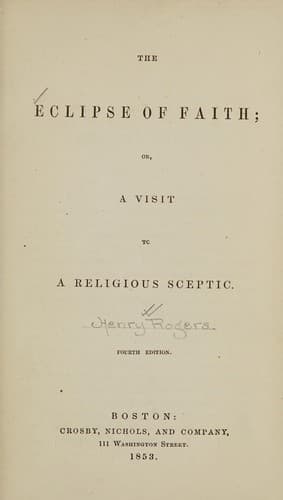
The Eclipse of Faith; Or, A Visit to a Religious ScepticRogers, Henry
Religion
The Eclipse of Faith; Or, A Visit to a Religious Sceptic
Rogers, Henry
Skepticism -- Controversial literature
the daring, but glorious, project of embodying and dramatizing the
ideal of the system they inculcated in the person of Christ? And yet
they have succeeded, though choosing to attempt the wonderful task in
a life full of unearthly incidents, which they have somehow wrought
into an exquisite harmony! But even if one such man in such an age
and nation could have been found equal to all this, could we, I argued,
believe that several (with undeniable individual varieties of manner)
were capable of working into the picture similarly unique, but
different materials, with similar success, and of reproducing the same
portrait, in varying posture and attitude, of the great Moral Idea?
Could we believe that, in achieving this task, not one, but several,
were intellectual magicians enough to solve that great problem of
producing compositions in a form independent of language,--of laying
on colors which do not fade by time; so that while Homer, Shakspeare,
Milton, suffer grievous wrong the moment their thoughts are transferred
into another tongue, these men should have written so that their
wonderful narrative naturally adapts itself to every dialect under
heaven?
These intellectual anomalies, I confessed,--if these had been all,--
staggered me. As Lord Bacon said that he would sooner believe "all the
fables of the Talmud, than that this universal frame was without a
mind," so I could sooner believe all those fables, than that minds
that can only produce Talmuds should have conceived such fictions as
the Gospel. I could as soon believe that some dull chronicler of the
Middle Ages composed Shakspeare's plays, or a ploughman had written
Paradise Lost; only that, to parallel the present case, we ought to
believe that four ploughmen wrote four Paradise Losts! Nay, I said,
I would as soon believe that most laughable theory of learned folly,
that the monks of the Middle Ages compiled all the classics! Nor could
it help me to say that it was Christians, not Jews, who compiled the
New Testament; for they must have been Jews before they were Christians:
and the twofold moral and intellectual problem comes back upon our
hands,--to imagine how the Jewish mind could have given birth to the
ideas of Christianity, or have embodied them in such a surpassing form.
And as to the intellectual part of the difficulty,--unhappily abundant
proof exists in Christian literature that the early Christians could as
little have manufactured such fictions as the Jews themselves! The
New Testament is not more different from the writings of Jews, or
superior to them, than it is different from the writings of the
Fathers, and superior to them. It stands alone, like the Peak of
Teneriffe. The Alps amidst the flats of Holland would not present a
greater contrast than the New Testament and the Fathers. And the further
we come down, the less capable morally, and nearly as incapable
intellectually, do the rapidly degenerating Christians appear, of
Public-domain text, read in full here on John Shaqi.
Reviews
Reviews
No reviews yet
Be the first to share your thoughts on this work.
Elsewhere in the archive
Join the Discussion
Join the discussion
Sign in to leave a comment or review.
Sign InorCreate an account