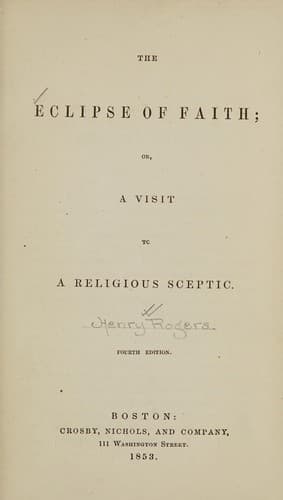
The Eclipse of Faith; Or, A Visit to a Religious ScepticRogers, Henry
Religion
The Eclipse of Faith; Or, A Visit to a Religious Sceptic
Rogers, Henry
Skepticism -- Controversial literature
Yes, I said, there are discrepancies, I admit; and I was about to
mention that as another difficulty in the way of my reception of his
theory: I refer to the nature and the limits of those discrepancies.
If there had been an absolute harmony, even to the mildest point, I
am persuaded that, on the principle of evidence in all such cases,
many would have charged collusion on the writers, and have felt that
it was a corroboration of the theory of the fictitious origin of these
compositions. But as the case stands, the discrepancies, if the
compositions be fictitious indeed, are only a proof that these men
attained a still more wonderful skill in aping verisimilitude than
if there had been no discrepancies at all. They have left in the
historic portions of their narrative an air of general harmony, with
an exquisite congruity in points which lie deep below the
surface,--a congruity which they must be supposed to have known would
astonish the world when once discovered; and have at the same time left
certain discrepancies on the surface (which criticism would be sure to
point out), as if for the very purpose of affording guaranties and
vouchers against the suspicion of collusion. The discords increase the
harmony. Once more, I asked, could I believe Jews, Jews in the reign of
Tiberius or Nero, equal to all these wonders?
But all this, even all this, I said, was as nothing compared with
another difficulty involved in this theory. How came these fictions,
containing such monstrous romance, if romance at all, and equally
monstrous doctrines, to be believed; to be believed by multitudes of
Jews and Gentiles, both opposed and equally opposed to them by previous
inveterate superstition and prejudice? How came so many men of such
different races and nations of mankind to hasten to unclothe themselves
of all their previous beliefs in order to adopt these fantastical
fables? How came they to persist in regarding them as authoritative
truth? How came so many in so many different countries to do this at
once? Nay, I added with a laugh, I think there are distinct traces,
as far as we have any evidence, that these very peculiar fictions must
have been believed by many before they were even compiled and published.
My infidel friend mused, and at last said, "I agree with you that
these compositions could not have been fictions in the ordinary
sense, that is, deliberately composed by a conspiracy of highly
imaginative minds. That last argument alone, of their success,
is conclusive against that; but may they not have been legends
which gradually assumed this form out of floating traditions
and previous popular and national prepossessions?" In short, he
faintly sketched a notion somewhat similar to that mythic theory,
since so elaborately wrought out by Strauss.
Public-domain text, read in full here on John Shaqi.
Reviews
Reviews
No reviews yet
Be the first to share your thoughts on this work.
Elsewhere in the archive
Join the Discussion
Join the discussion
Sign in to leave a comment or review.
Sign InorCreate an account