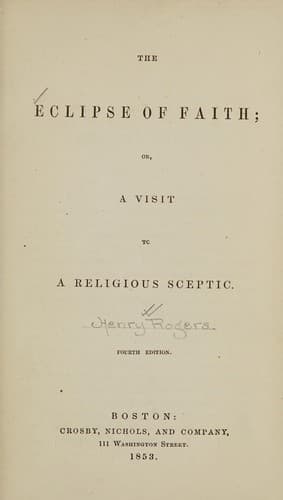
The Eclipse of Faith; Or, A Visit to a Religious ScepticRogers, Henry
Religion
The Eclipse of Faith; Or, A Visit to a Religious Sceptic
Rogers, Henry
Skepticism -- Controversial literature
man has the manufacture of it) is almost impossible, because the
relations of fact that must be anticipated and provided against are
so infinitely various, that the writer is certain to betray himself.
The constant detection of very limited fabrications of a similar
nature, when evidence is sifted in a court of justice, shows us the
impossibility of weaving a plausible texture of this kind.
Many things are sure to have been forgotten which ought to have
been remembered. If this be the case, even where one mind has the
fabrication of the whole, how much more would it be the case if many
minds were engaged in the conspiracy? Should we not expect, at the
very least, the hesitating, suspicious, self-betraying tone usual
in all such cases? Could we expect that general air of truth which
so undeniably prevails throughout the New Testament,--the inimitable
tone of nature, earnestness, and frank sincerity, which, in the case
of such extravagant forgeries, would alone be marvellous traits? But,
at all events, could we expect those minute coincidences, which lay
too deep for the eye of all ordinary readers, and would never have
been discovered had not infidelity provoked Paley and others to
excavate those subterranean galleries in which they are found?
And here again I interrupted my narrative to remark, that Professor
Newman acknowledges the force of these coincidences, and, as usual,
gives no account of them. He says of the Horae Paulinae, in his
"Phases": "This book greatly enlarged my mind as to the resources of
historical criticism. Previously my sole idea of criticism was that
of the discreet discernment of style; but I now began to understand
what powerful argument rose out of combinations; and the very complete
establishment which this work gives to the narrative concerning Paul
in the latter half of the Acts appeared to me to reflect critical honor
on the whole New Testament." (Phases, p. 23.)
But once more to resume my statement. Upon mentioning these and such
like considerations to my infidel friend, who pleaded, that the New
Testament was fiction, he replied. "As to the harmony in these fictions,
--if they be such,--you acknowledge that it is not absolute: that are
discrepancies."
Public-domain text, read in full here on John Shaqi.
Reviews
Reviews
No reviews yet
Be the first to share your thoughts on this work.
Elsewhere in the archive
Join the Discussion
Join the discussion
Sign in to leave a comment or review.
Sign InorCreate an account