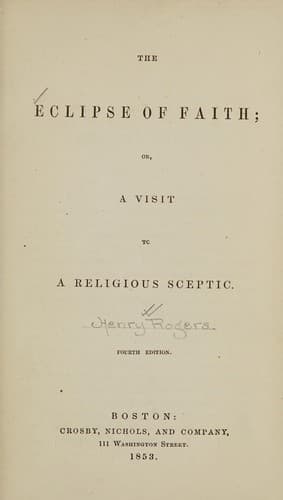
The Eclipse of Faith; Or, A Visit to a Religious ScepticRogers, Henry
Religion
The Eclipse of Faith; Or, A Visit to a Religious Sceptic
Rogers, Henry
Skepticism -- Controversial literature
Such, I said, to conclude, was an imperfect outline of some of my early
conflicts, and such the cruel mode in which my unbelieving friends
laughed at each other's hypotheses, and left me destitute of any.
Finding that they conclusively confuted one another, and perceiving
at last that the idea of the superhuman origin of Christianity did,
and, as Bishop Butler says, alone can resolve all the difficulties of
the subject, I was compelled to forego all the advantages of infidelity,
and condescended to "depress" my conscience to the "Biblical standard"!
Would to Heaven that it had never been depressed below it!
I am bound to say my auditors listened with courtesy. The conversation
was now carried on in little knots: I, who was glad of a rest, was
occupied in listening to a conversation between Harrington and his
Italian friend, who was urging him to take refuge from such a Babel
of discords as his company had uttered, in the only secure asylum.
Harrington told him, with the utmost gravity, that one great objection
to the Church of Rome was the unseemly liberty she allowed to the
right of private judgment; that he found in her communion distractions
the most perplexing, especially as between English and foreign Romanists!
____
After the party had broken up, and we were left alone, Mr. Fellows,
turning to me, said, "You lay great stress on the origination of
such a character as Christ. But can we make its reality a literary
problem? May it not have been imaginary? As Mr. Newman says, Human
nature is often portrayed in superhuman dignity; Why not in
superhuman goodness?
"That the origination;" said I, "of such a Moral Ideal, in so
peculiar a form, by such men as Galilean Jews, is unaccountable
enough, I fancy all will admit; but it is, you observe, only one of
the numberless points which are unaccountable; neither do I make
this one feature, or any of the other singular characteristics of
the New Testament, merely a literary problem. The whole, you see,
is a vast literary, moral, intellectual, spiritual, and historical
problem. But it is too much the way with you objectors to say, 'This
may, perhaps, be got over,' and 'That may be got over'; the question
is, as Bishop Butler says, whether all can be got over; for if all
the arguments for it be not false, Christianity is true.
"You charge us with the very conduct," retorted Fellowes, "which Mr.
Newman objects to Christians. They, says he, affirm that this objection
is of little weight, and that is of little weight; whereas altogether
they amount to considerable weight."
"I admit it," said I; "and those are very unfair who deny it. But
still, since there are these things of weight on both sides, the
argument returns, on which side does the balance on the sum-total of
evidence lie?"
"But," said Fellowes, "how few are competent to compute that!"
Public-domain text, read in full here on John Shaqi.
Reviews
Reviews
No reviews yet
Be the first to share your thoughts on this work.
Elsewhere in the archive
Join the Discussion
Join the discussion
Sign in to leave a comment or review.
Sign InorCreate an account