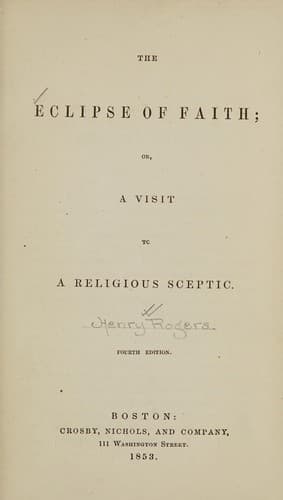
The Eclipse of Faith; Or, A Visit to a Religious ScepticRogers, Henry
Religion
The Eclipse of Faith; Or, A Visit to a Religious Sceptic
Rogers, Henry
Skepticism -- Controversial literature
"You are really pleasant, Mr. Fellowes," I replied; "I thought the
question we were arguing was as to the truth or the falsehood of
Christianity, not whether the bulk of mankind are fully competent to
form an independent and profound judgment on its evidences: very
few are competent to do so either on this or any other complex subject;
certainly not (as our differences show) on the subject of your
'spiritualism.' But the incompetency of the great bulk of mankind to
deal with complicated evidence makes a thing neither true nor false;
perhaps on this, as on so many other subjects, the few must thoroughly
sift the matter for the many. If your present objection were of force,
what would become of truth in politics, law, medicine, in all which
the great majority must trust much to the conclusions of their wiser
fellow-creatures? Your observation is no confutation of the evidences
for Christianity: it is simply a satire upon God and the condition
of the human creatures he has made!"
"Well, let that pass," said Fellowes; "I was going to say further,
that it is not so clear to every one that Christ is so very wonderful
an ideal of humanity. Do you remember that Mr. Newman says in his
'Phases,' that, when he was a boy, he read Benson's Life of
Fletcher of Madely, and thought Fletcher a more perfect man than
Jesus Christ? and he also says that he imagines, if he were to read
the book again, he would think the same. Have you nothing to say
to that?"
"NOTHING," said I, "except to point you to the infinitely different
estimates of Christ formed by other men who yet think of historical
Christianity much as you do. How differently do such writers as
Mr. Greg and Mr. Parker speak! How do they almost exhaust the
resources of language to express their sentiments of this wonderful
character! As to Mr. Newman's impression, I do not think it worth
an answer. When a man so far forgets himself as to say what he can
hardly help knowing will be unspeakably painful to multitudes of his
fellow-creatures, on the strength of boyish impressions,--not even
thinking it worth while to verify those impressions, and see whether,
after thirty or forty years, he is not something more than a boy,--I
think it is scarcely worth while to reply. Christianity is willing to
consider the arguments of men, but not the impressions of boys."
"But we must not be too hard." said Harrington, "upon Mr. Newman; it
is evident, from his Hebrew Monarchy, that, as he takes a benevolent
pleasure in defending those whom nobody else will defend,--in petting
Ahab, whom he pronounces rather weak than wicked, and palliating Jezebel,
whose character was, it seems, grievously deteriorated by contact with
the 'prophets of Jehovah,'--so he has a chivalrous habit of depressing
those who have been particularly the objects of veneration. Elisha,
Samuel, and David are all brought down a great many degrees in the moral
scale. He has simply done the same with Christ."
Public-domain text, read in full here on John Shaqi.
Reviews
Reviews
No reviews yet
Be the first to share your thoughts on this work.
Elsewhere in the archive
Join the Discussion
Join the discussion
Sign in to leave a comment or review.
Sign InorCreate an account