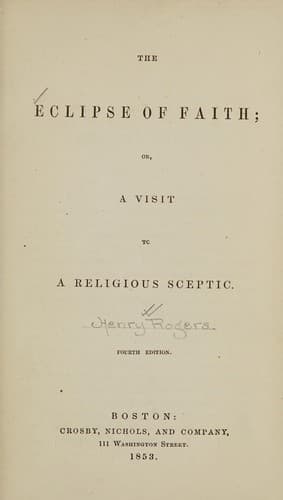
The Eclipse of Faith; Or, A Visit to a Religious ScepticRogers, Henry
Religion
The Eclipse of Faith; Or, A Visit to a Religious Sceptic
Rogers, Henry
Skepticism -- Controversial literature
I replied, that, of course, it would be of no avail to affirm in
general (what I was yet convinced was true), that the New Testament
inculcated a system of ethics much more just and comprehensive than
any other volume in the world. I told him, however, that I thought
he would not deny that its manner of conveying ethical truth was unique;
that it not only contained more admirable and varied summaries of duty
than any other book whatever, but that we should seek in vain in any
other for such a profusion of just maxims and weighty sentiments,
expressed with such comprehensive brevity, or illustrated with so
much beauty and pathos. I remarked that, if he would be pleased to
do as I had once done,--compile a selection of the principal precepts
and maxims from the most admirable ethical works of antiquity (those
of Aristotle, for example), and compare them with two or three of the
summaries of similar precepts in the New Testament,--he would at once
feel how much more vivid, touching, animated, and even comprehensive,
was the Scriptural expression of the same truths. But I further observed,
that, even to obtain the means of such comparison, he must reject from
Plato or the Stagyrite twenty times the bulk of questionable
speculations, and dreary subtilties, which separate by long intervals
those gems of moral truth, which everywhere sparkle on the pages of
the New Testament.
I told him I could not help laying great stress on the degree and manner
in which this element enters into the composition of the New Testament;
that ethical truths are there expressed in every variety of form which
can fix them upon the imagination and the heart, with an entire absence
of those prolix discussions and metaphysical refinements which form so
large a portion of Aristotle and Plato. If we find in these writers a
moral truth expressed with something approaching the comprehensive
beauty and simplicity of the Gospels, we are filled with surprise and
rapture, and dig out with joy the glittering fragment from the mass of
earthy matter,--oppressive disquisitions about "ideas" and "essences,"
"energies" and "entelechies," and so forth, in which it is sure to be
imbedded. I promised, if health and life were given, to exhibit some
day these gems, with a sufficient portion of the surrounding earth
still attached to them, and to contrast them with those of the New
Testament. "In this strange volume," I continued, "the most beautiful
ethical maxims exist in unexampled profusion. After reading Aristotle's
ethics, I feel, when I turn to the New Testament, as Linnaeus is said
to have felt when he first saw growing wild the masses of blooming gorse,
which he had never seen in his cold North, except as a sheltered
exotic. Whether it was likely that contemporaries of the Pharisees, who
were sunk in formalism, and who had glossed away every moral and
spiritual the Law, could reach and maintain such elevation of tone,
I leave you to judge." But though I felt this, I acknowledged that
Public-domain text, read in full here on John Shaqi.
Reviews
Reviews
No reviews yet
Be the first to share your thoughts on this work.
Elsewhere in the archive
Join the Discussion
Join the discussion
Sign in to leave a comment or review.
Sign InorCreate an account