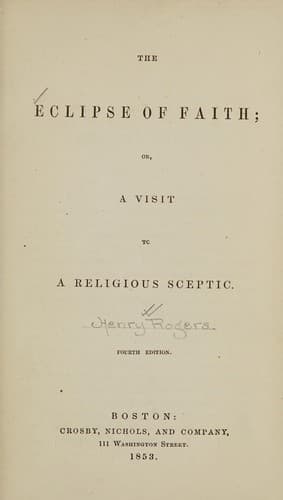
The Eclipse of Faith; Or, A Visit to a Religious ScepticRogers, Henry
Religion
The Eclipse of Faith; Or, A Visit to a Religious Sceptic
Rogers, Henry
Skepticism -- Controversial literature
it was difficult to express it; and said that perhaps the best way to
compare the morality of the New Testament with the ethical system of
any philosopher, or the code of any legislator, would be to imagine
them all universally adopted, and see how much would have to be
objected to,--how much "brick" was mingled with the "porphyry." "If,
for example," said I, "Plato, who, I admit, so flashes upon us the
sublimest and most comprehensive principles of morals, and whose
ethical system you say is identical with that of Christianity, had
the forming of a republic, you would have community of women property,
--women trained to war,---infanticide certain circumstances,--young
children led to battle (though at a safe distance), that 'the young might
early scent carnage, and be inured to slaughter! Both with him and
Aristotle slavery would be a regularly sanctioned and perfectly
natural institution. Not only did they entertain very lax notions
of the relation of the sexes, but the tone in which they speak of
most abominable corruptions--I do not except cannibalism--to which
humanity has ever degraded implied that they regarded such things
as comparatively venial. I know no greater single names than these,
and I presume that these points you would find so, difficulty in
digesting." He admitted it.
I told him I supposed he would take equal objections to the Gentoo, or
the Roman, or the Spartan code, as also to the Koran. He admitted all
this too.
"But now, if we take the Christian code, and suppose the New Testament
made the literal guide of in every man, tell me, Mr. Fellowes, what
would the consequence? What would you wish otherwise?"
"Why," said Harrington, smiling, "he would, perhaps, object that
there would be no more war, and that retaliation would be impossible."
"The former," said I, "we could all endure, I suppose; nor be
unwilling to give up the latter, seeing that there would, in that
case, be no wrongs to avenge. It would not matter that you would be
compelled to turn your right cheek to him who smote you on the left
(let the interpretation be as literal as you will), since no one would
strike you on the left; nor that you must surrender your cloak to him
who took away your coat, since no one would take your coat. But tell
me, is there any thing more serious that would follow from the literal
and universal adoption of the ethics of the New Testament?" Fellowes
acknowledged that he knew of nothing, unless it was a sanction
of slavery.
"I do not admit that the New Testament sanctions it," I replied; "and
I will, if you like, give my reasons in full, another time. But is
there any thing else?"
He said he did not recollect any thing.
"But you would recoil from the literal realization of the systems and
codes we have mentioned." He confessed this also.
Public-domain text, read in full here on John Shaqi.
Reviews
Reviews
No reviews yet
Be the first to share your thoughts on this work.
Elsewhere in the archive
Join the Discussion
Join the discussion
Sign in to leave a comment or review.
Sign InorCreate an account