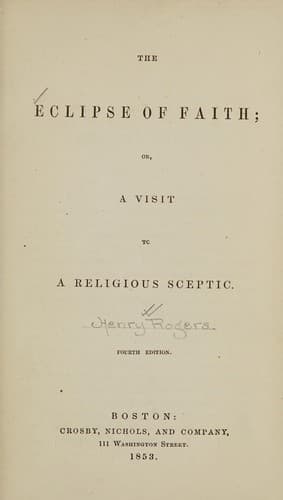
The Eclipse of Faith; Or, A Visit to a Religious ScepticRogers, Henry
Religion
The Eclipse of Faith; Or, A Visit to a Religious Sceptic
Rogers, Henry
Skepticism -- Controversial literature
clear internal oracle which He had planted in the human breast; in
a word, that, if it was a rebuke at all, it was a rebuke to a rampant
"Bibliolatry." As I heard all these different versions of so simple
a matter, and found that not a few were inclined to each, I could,
not help exclaiming, "In truth the Devil is a very clever fellow,
and man even a greater blockhead than I had taken him for." But in
spite of the surprise with which I had listened to these various
explanations of an event which seemed to me clear as if written
with a sunbeam, this last reason, which assigned as the cause of
God's resumption of his own gift, an extravagant admiration and
veneration of it on the part of mankind,--it being so notorious
that those who professed belief in its divine origin and authority
had (even the best of them) so grievously neglected both the
study and the practice of it,--struck me as so exquisitely
ludicrous, that I broke into a fit of laughter, which awoke me.
I found that it was broad daylight, and the morning sun was
streaming in at the window, and shining in quiet radiance upon
the open Bible which lay on my table. So strongly had my dream
impressed me, that I almost felt as though, on inspection, I
should find the sacred leaves a blank, and it was therefore
with joy that my eyes rested on those words, which I read through
grateful tears: "The gifts of God are without repentance."
____
July 19. This morning my friends treated me to a long dialogue in
which it was contended
THAT MIRACLES ARE IMPOSSIBLE, BUT THAT IT IS IMPOSSIBLE TO PROVE IT.
"I think, Fellowes," Harrington began, "if there be any point in
which you and I are likely to agree, it is in that dogma that miracles
are impossible. And yet here, as usual, my sceptical doubts pursue
and baffle me. I wish you would try with me whether there be not an
escape from them." Fellowes assented.
"As I have to propose and explain my doubts," said Harrington, "perhaps
you will excuse my taking the 'lion's share' of the conversation. But
now, by way of beginning in some way,--what, my dear friend, is a
miracle?"
"What is a miracle? Ay, that is the question; but though it may be
difficult to find an exact definition of it, it is easily understood by
every body."
"Very likely; then you can with more ease give me your notion of it."
"If, for example," said Fellowes, "the sun which has risen so long,
every morning, were to rise no more; or if a man, whom we knew to be
dead and buried, were to come to life again; or if what we know to
be water were at once to become wine, none would hesitate to call that
a miracle."
"You remember, perhaps," said Harrington, "an amusing little play of
Socratic humor in the dialogue of Theaetetus, somewhere in the
introduction, when the ironical querist has asked that intelligent
youth what science is?
"I cannot say that I do; for though I have read that dialogue, it is
some years ago."
Public-domain text, read in full here on John Shaqi.
Reviews
Reviews
No reviews yet
Be the first to share your thoughts on this work.
Elsewhere in the archive
Join the Discussion
Join the discussion
Sign in to leave a comment or review.
Sign InorCreate an account