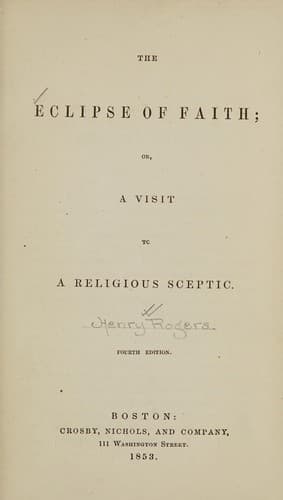
The Eclipse of Faith; Or, A Visit to a Religious ScepticRogers, Henry
Religion
The Eclipse of Faith; Or, A Visit to a Religious Sceptic
Rogers, Henry
Skepticism -- Controversial literature
"Let me read you the passage then. Here it is," said Harrington,
reaching down the dialogue and turning to the place. "'Tell me frankly,'
says Socrates, 'what do you think science is?' 'It appears to me,' says
Theaetetus, 'that such things as one may learn from Theodorus here,
--namely, geometry, as well as other things which you have just
enumerated; and again, that the shoemaker's art, and those of other
artisans,--all and each of them are nothing else but science.' 'You
are munificent indeed,' said Socrates; 'for when asked for one thing, you
have given many.' I almost think," continued Harrington, "that, if
Socrates were here, he would do what I should not presume to do,--banter
you in a somewhat similar way. He would say, that, having asked what
a miracle was, Mr. Fellowes told him that half a dozen things were
miracles, but did not tell him what every miracle was; that is, never
told him what made all miracles such. Suffer me again to ask you what a
miracle is?"
"I recollect now enough of the charming dialogue from which you have
taken occasion to twit me, to answer you in the same vein. As it
turns out, Socrates, appears to be at least equally ignorant with
Theaetetus as to the definition of which he is in search. I think it
may be as well for me to do at once what certainly Theaetetus would
have done, had he known that his reprover was as much in the dark
as himself."
"What is that?" said Harrington.
"He would have cut short a good deal of banter by at once turning
the tables upon his ironical tormentor; acknowledging his impotence,
and making him give the required definition. Come, let me take that
course."
"I have no objection, my friend, if you will first, as you say,
acknowledge your impotence; only I would not advise you, for in that
case you would be obliged to confess that you have resolved with me
that a miracle is impossible, and yet that you are not quite sure that
you can tell, or rather own that you cannot, what a miracle is. Let me
entreat you to essay some definition; and if you break down, I have no
objection to take my chance of the honor of success or the ignominy of
failure."
"The fact is," answered Fellowes, "that, like many other things, it
is better understood--"
"Than described, as the novelists say, when they feel that their powers
of description fail them. But this will hardly do for us; we are
philosophers, you know (save the mark!) in search of truth.--A
thing that is well known by every body, and is capable of being
described by nobody, would be almost a miracle of itself; and I
think it imports us to give some better account of the matter. I
can see that my orthodox uncle there is already secretly amusing
himself at the anticipation of our perplexities."
I took no notice of the remark, but went on writing.
Public-domain text, read in full here on John Shaqi.
Reviews
Reviews
No reviews yet
Be the first to share your thoughts on this work.
Elsewhere in the archive
Join the Discussion
Join the discussion
Sign in to leave a comment or review.
Sign InorCreate an account