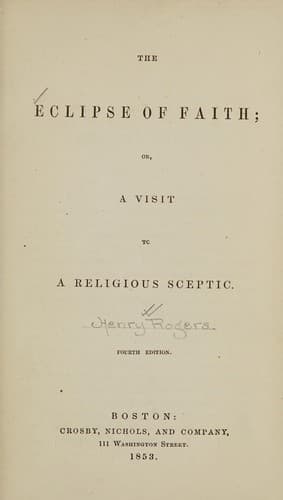
The Eclipse of Faith; Or, A Visit to a Religious ScepticRogers, Henry
Religion
The Eclipse of Faith; Or, A Visit to a Religious Sceptic
Rogers, Henry
Skepticism -- Controversial literature
"Well, then, if I must give you some definition," said Fellowes, "I
know not if I can do better than avail myself of the usual one, that
it is a suspension or violation of a law of nature. Is not that the
account which Hume gives of the matter?"
"I think it is. I am afraid, however, that at the very outset we should
have some difficulty in determining one of the phrases used in this
very definition,--namely, how we are to understand a law of nature. I
do not ask whether law implies a lawgiver; you will assert it, and I
shall not gainsay it: it is at present immaterial. But do you not mean
by a law of nature (I am asking the question merely to ascertain whether
or not we are thinking of the same thing) just this;--the fact that
similar phenomena uniformly reappear in an observed series of antecedents
and consequents, which series is invariable so far as we know, and so
far as others know, whose experience we can test? Is not that what
you mean? You do not, I presume, suppose you know any thing of the
connection which binds together causes and effects, or the manner in
which the secret bond (if there be any) which unites antecedents and
consequents, in any natural phenomena, is maintained?"
"I certainly make no such pretensions; all that I mean by a law of
nature is just what you have mentioned. I shall be well content to
adhere to your explanation," answered Fellowes.
"So that when we observe similar phenomena reproduced in the aforesaid
series of antecedents and consequents, we call that a law of nature,
and affirm that violation of that law would be a miracle, and
impossible?"
"Certainly."
"And further, do you not agree with me that such invariable series is
sufficiently certified to us by our own uniform experience,--that of
all our neighbors and friends,--and, in a word, that of all whose
experience we can test?"
"I agree with you."
"I am content," replied Harrington; "but at the outset it seems to me
that the expression I have used requires a little expansion to meet
the sophistry of our opponents. I will either explain myself now, and
then leave you to judge; or I will say no more of the matter here, but
pursue our discussion, and let the difficulty (if there be one) disclose
itself in the course of it, and be provided for as may be in our power."
"What is it?"
Public-domain text, read in full here on John Shaqi.
Reviews
Reviews
No reviews yet
Be the first to share your thoughts on this work.
Elsewhere in the archive
Join the Discussion
Join the discussion
Sign in to leave a comment or review.
Sign InorCreate an account