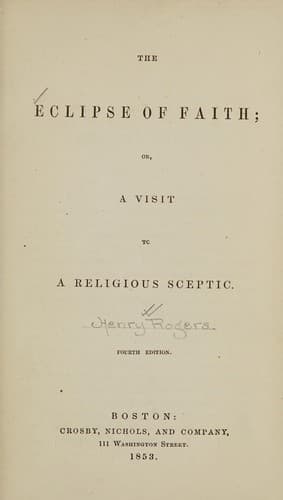
The Eclipse of Faith; Or, A Visit to a Religious ScepticRogers, Henry
Religion
The Eclipse of Faith; Or, A Visit to a Religious Sceptic
Rogers, Henry
Skepticism -- Controversial literature
"Very well; only in the mean time you are in the ludicrous position
of facing a phenomenon of which you do not know whether you will call
it a miracle or not,--the contingency, meantime, on which it is to be
decided, not at all, as I contend, affecting the matter; since you
allow that it is the infraction of the previously established order
of sequences, as known to uniform experience, which constitutes a
miracle! If so, I must maintain that the creation of man was, for
the same reasons, of the essence of a miracle. You seem to think
there is no objection to the admission of miracles, provided they are
astounding and numerous enough; or provided they are a long time about,
instead of being instantaneously wrought. I must remind you, that to
the principle of our argument these things are quite immaterial. Whether
the revolution by which the established order of sequences is absolutely
infringed,--the face of the universe or of our globe transformed, or
an entirely new race (as, for example, man) originated,--I say, whether
such change be produced slowly or quickly is of no consequence in the
world to our argument. It is whether or not a series of phenomena
be produced as absolutely transcending the sphere of all experience,
as those events we admit to be impossible, called 'miracles.' That the
introduction of man upon the earth for the first time (for you will not
allow his race eternal), or the origination of a sun, is not at all
to be reckoned as transcending that experience, I cannot understand.
Nor can I understand it a bit better by your saying that it, is in
conformity with the vague something you are pleased to call a law.
It is a safe phrase, however; for as neither you nor any one else
can interpret it, no one can refute you. This law is a most convenient
thing! It repeals, it appears to me, all other laws,--even those of
logic. Perhaps would be better to say that miracles are no miracles
when they are 'lawful' miracles. No! let us keep our principle intact
from all such dangerous admissions as these. In that way only
are we safe."
"Safe do you call it? I see not how, if we carry out this principle
in the way and to the extent you propose, we can reply to the atheist
or to the pantheist, who tells us that the universe is but an
eternal evolution of phenomena in one infinite series, or in an
eternal recurrence of finite cycles."
"And what is that to you or me? How can we help our principle (if we
are to hold it at all) leading to some such conclusion? We are, I
presume, anxious to know the truth. You see that Strauss, who is the
most strenuous assertor of the impossibility of miracles, is also a
pantheist. I know not whether you may not become one yourself."
"Never," said Fellowes, vehemently; "never, I trust, shall I yield
to that 'desolating pantheism' (as worthy Mr. Newman calls it) which
is now so rife."
Public-domain text, read in full here on John Shaqi.
Reviews
Reviews
No reviews yet
Be the first to share your thoughts on this work.
Elsewhere in the archive
Join the Discussion
Join the discussion
Sign in to leave a comment or review.
Sign InorCreate an account