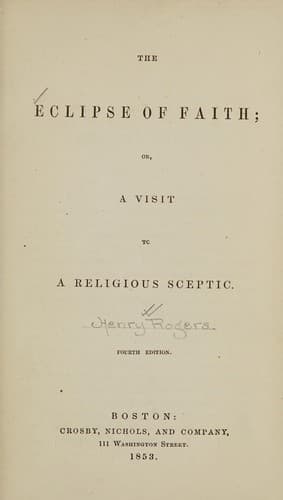
The Eclipse of Faith; Or, A Visit to a Religious ScepticRogers, Henry
Religion
The Eclipse of Faith; Or, A Visit to a Religious Sceptic
Rogers, Henry
Skepticism -- Controversial literature
"I think Mr. Newman's principles ought to guide you thither. You
seem to hold fast by his skirts at present; but I very much doubt
whether you have yet reached the termination of your career. You
have, you must admit, made advances quite as extraordinary before.
"We shall see.--But I suppose you have reached the end of the
objections which your wayward scepticism suggests against a
conclusion which we both admit; or have you any more?"
"O, plenty; and amongst the rest, I am afraid we must admit--whether
we admit or not your expedient of law--a miracle, or something
indistinguishable from it, as involved in the creation and
preservation of the first man,--since you will have a first man."
"What do you mean?"
"I mean, that supposing the creation of man to be no miracle, because
he entered by law; or that that first fact (which would otherwise be
miraculous) is not such, simply because it is the first of a series
of such facts,--I should like to see whether we have not even then
to deal with a miracle, or a fact as absolutely unique; and which was
not connected with any series of similar facts."
"I think you would find it very hard to prove it."
"Nous verrons. I am sure we shall not disagree as to the fact that man,
however he came into the world, sooner or later, by ordinary or
extraordinary methods, by some lawful wedlock of nature, or by some
miracle which is not 'lawful,' is endowed by nature with various
faculties and susceptibilities."
"Certainly," said Fellowes, laughing; "if you demand my assent to
nothing more than that, I shall easily admit your premises and
deny your conclusion."
"You will also admit, I think, that the process by which man comes
to the use of these faculties, and powers, and so forth, is
very gradual?"
"Assuredly."
"And will you not also admit that the development and command of
these is something very different from the, potentialities themselves,
as my uncle here would call them?--that, for example, we have the
faculty of vision; but that the art of seeing involves a slow
laborious process, acquired not without the concurrent exercise of
other senses: and that the apparatus for walking is perfect even in
an infant; but that the art of walking is, in fact, a wonderful
acquisition: further, that the command given us by these faculties,
as actually exercised, is immensely greater than would be conferred
by each alone. In one word, you will allow that man, when he comes
to the use of his faculties, is, as has been well said, a bundle of
habits, or, as Burke puts it, is a creature who, to a great extent,
has the making of himself."
"I am much at my ease," said Fellowes; "I shall not dispute any
of these premises either."
"And will you not also admit that, as man comes into the world now,
a long time is required for this development; and that during that
time he is absolutely dependent on the care of those who have already
in their turn required similar care?"
Public-domain text, read in full here on John Shaqi.
Reviews
Reviews
No reviews yet
Be the first to share your thoughts on this work.
Elsewhere in the archive
Join the Discussion
Join the discussion
Sign in to leave a comment or review.
Sign InorCreate an account