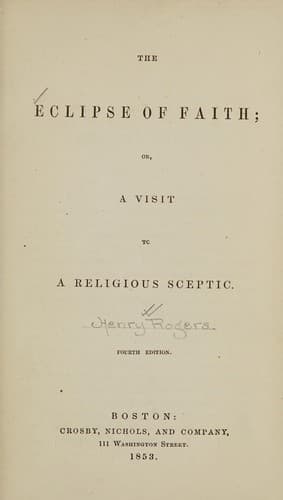
The Eclipse of Faith; Or, A Visit to a Religious ScepticRogers, Henry
Religion
The Eclipse of Faith; Or, A Visit to a Religious Sceptic
Rogers, Henry
Skepticism -- Controversial literature
"Why, then, is not this plainly to make a belief of such events depend
upon testimony, and do we not give up altogether our sufficient
principle of rejection of all such testimony? You are yielding,
without doubt, the principle of our opponents, who affirm that there
is no event so improbable that a certain combination of testimony
would not be sufficient to warrant your reception of it; because, as
they say, that testimony might be given under such circumstances,--so
variously certified, and so above suspicion,--that it would be more
improbable that the statement to which it applied (however strange)
should be false, than that the testimony should not be true; in other
words, that the falsehood of the testimony would be the greater miracle
of the two. And they say this, because (as they assert) the uniform
experience on which we found our objection to any miraculous narrative
is no less applicable to the world of mind than to the world of matter;
that there is not indeed an absolute uniformity of experience in the
former, as neither is there in the latter; but neither in one nor in
the other is there any absolute bouleversement of the principles and
constitution of nature; which, they say, would be implied, if under
all conceivable circumstances testimony might prove false. And yet
now you seem to admit the very thing for which they contend; and in
contending for it, you give up your case. Doing so, you certainly get
rid of the paradoxical conclusions which my wretched scepticism
sometimes suggests to me, as throwing a doubt on the integrity of our
principle. I say your admission gets rid of it; but then it is with
the ruin of the principle itself."
"What was that paradox?"
"It is this; that, if we adhere to our principle, we must deny that any
amount of testimony is sufficient to warrant the belief of a miracle."
"That is what we do maintain."
"I thought so; but you seem to me to have hastily given it up. Let us
then again maintain that our prince, in denying what was a miracle
to him, was not only consistent in saying that it could not be, when
first asserted to him, but also when last asserted; and died an orthodox
infidel in the possibility of ice, or an orthodox believer in the
eternal fluidity of water, whichever you prefer to consider it."
"Well, and what then?"
"Why, then, let us act upon our principle with equal consistency in
other cases; for you say that there is no amount or complexity of
evidence which would induce you to believe in a miracle."
"I do."
Public-domain text, read in full here on John Shaqi.
Reviews
Reviews
No reviews yet
Be the first to share your thoughts on this work.
Elsewhere in the archive
Join the Discussion
Join the discussion
Sign in to leave a comment or review.
Sign InorCreate an account