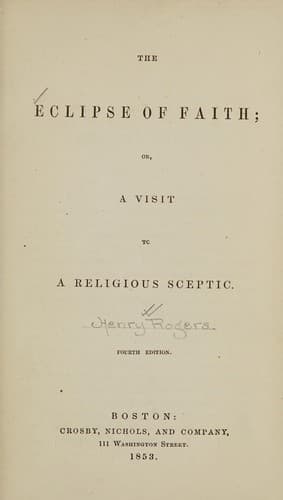
The Eclipse of Faith; Or, A Visit to a Religious ScepticRogers, Henry
Religion
The Eclipse of Faith; Or, A Visit to a Religious Sceptic
Rogers, Henry
Skepticism -- Controversial literature
"Let us suppose it was asserted that a man known to have been dead
and buried had risen again, and, after having been seen by many, had
at last, in presence of a multitude, on a clear day, ascended to
heaven through the calm sky, without artificial wings or balloon, or
any such thing; that he was seen to pass out of sight of the gazing
crowd, who watched and watched in vain for his return; and that he had
never more been seen. Let us suppose that the witnesses who saw this
constantly affirmed it; that amongst them were many known to you,
whose veracity you had no reason to suspect, and who had no imaginable
motive to deceive you; let us suppose further, that they persisted in
affirming this, in spite of all contumely and contempt, insult and
wrong, amidst threats of persecution, and persecution itself; lastly,
let there be amongst them many, who before this event had been as
strenuous assertors of the impossibility of a miracle as yourself.
I want to know whether you would believe this story, thus authenticated,
or not?"
"But it is, I think, unfair to put any such case; for there never was
such an event so authenticated."
"It is quite sufficient to test our principle, that you can imagine
such testimony. If that principle is sound, it is plain that it will
apply to all imaginable degrees of testimony, as well as to all actual.
No testimony, you say, can establish a miracle. This is true or not.
If you admit that there are any degrees in this matter, you come at
last to the old argument, which you abjure; namely, that whether a
miraculous event has taken place or not depends on the degree of
evidence with which it is substantiated, and that must be the result
of a certain investigation of it in the particular alleged case.
You remember the story of the ring of Gyges, which made the wearer
invisible. Plato tells us how a man ought to act, and how a good man
would act, if he had such a ring. Cicero tells us how absurd it would
be to reply to his reasoning (as one did), by saying that there never
was such a ring. It was not necessary to the force of the illustration
that there should be such a ring. So neither is it necessary to my
argument there should be such testimony as I have supposed, to enable
us to see whether we are prepared to admit the truth of your principle
that no evidence can establish a miracle. Once more, then, I ask you
whether, on supposition of such testimony, you would reject the
supposed fact or not?"
"Well, then, I should say, that, since no testimony can establish a
miracle, I should reject it."
"Bravo, Fellowes! I do of all things like to see an unflinching
regard to a principle, when once laid down."
"But would not you also reject it, upon the same principle?"
Public-domain text, read in full here on John Shaqi.
Reviews
Reviews
No reviews yet
Be the first to share your thoughts on this work.
Elsewhere in the archive
Join the Discussion
Join the discussion
Sign in to leave a comment or review.
Sign InorCreate an account