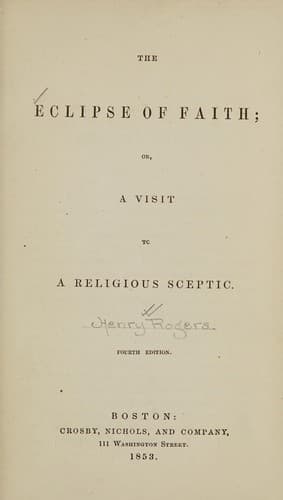
The Eclipse of Faith; Or, A Visit to a Religious ScepticRogers, Henry
Religion
The Eclipse of Faith; Or, A Visit to a Religious Sceptic
Rogers, Henry
Skepticism -- Controversial literature
"I wish this could help us; but it plainly will not; because we have
concluded that, if there were such testimony, we must believe it false,
and therefore should admit that the miracle of its falsehood was, in
that case, necessary to be believed; not to say that there has been,
in the opinion of millions, testimony often given to miracles, which,
if false, does imply that the laws of human nature must have been
turned topsy-turvy,--and I, for my part, know not how to disprove it.
If, in such cases, the testimony, the falsity of which would be a
miracle, is not to be rejected, then we must admit that the miracle
which it supports is true. I must leave it there." said Harrington,
with an air of comic resignation; "I cannot answer for any thing
except that you may reject both miracles alternatively, if that
will be any comfort to you, without being able to disbelieve
simultaneously. If you believe the testimony false, you must believe
the alleged miracle false; but you will have then the moral miracle
to believe. If you believe the testimony true, you will then believe
the physical miracle true. Perhaps the best way will be to believe both
alternately in rapid succession; and you will then hardly perceive the
difficulty at all!"
There was here a brief pause. Harrington suddenly resumed. "These
are very perplexing considerations. One thing, I confess, has often
puzzled me much; and that is,--what should we do, in what state of
mind should we be, if we did see a miracle?"
"Of what use is the discussion of such a particular case, when you know
it is impossible that we should ever see it realized?" replied Fellowes.
"Of course it is; just as it is impossible that we should ever see
levers perfectly inflexible, or cords perfectly flexible. Nevertheless,
it is perfectly possible to entertain such a hypothetical case, and
to reason with great conclusiveness on the consequences of such a
supposition; and in the same way we can imagine that we have seen a
miracle; and what then?"
"Why, if we were to see one, of course seeing is believing. We must
give up our principle," said Fellowes, laughing.
"Do you think so? I think we should be very foolish then. How can we
be sure that we have seen it? Can it appeal to any thing stronger
than senses, and have not our senses often beguiled us?" Must we not
rather abide by that general induction from the evidence to which our
ordinary experience points us? In other words, ought we not to adhere
to the great principle we have already laid down, that a miracle
is impossible?"
"But, according to this, if we err in that principle, and God were to
work a miracle for the very purpose of convincing us, it would be
impossible for him to attain his purpose."
Public-domain text, read in full here on John Shaqi.
Reviews
Reviews
No reviews yet
Be the first to share your thoughts on this work.
Elsewhere in the archive
Join the Discussion
Join the discussion
Sign in to leave a comment or review.
Sign InorCreate an account