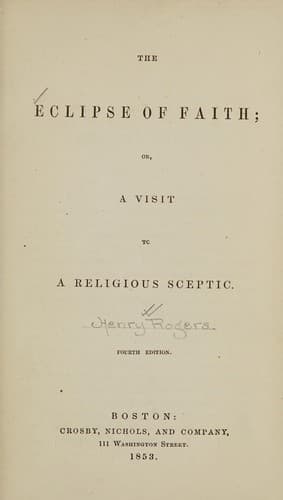
The Eclipse of Faith; Or, A Visit to a Religious ScepticRogers, Henry
Religion
The Eclipse of Faith; Or, A Visit to a Religious Sceptic
Rogers, Henry
Skepticism -- Controversial literature
"I think it would, my friend, I confess; just for the reason that,
since we believe a miracle to be impossible, we must believe it
impossible for even God to work one; and therefore, if we are
mistaken, and it is possible for him to work one, it is still
impossible that he should convince us of it."
"I really know not how to go that length."
"Why not? You acknowledge that your senses have deceived you; you know
that they have deceived others; and it is on that very ground that
you dispose of very many cases of supposed miracles which you are
not willing, or are not able, to resolve otherwise. If I believe, then,
that a miracle is impossible, I must admit that, if I err in that, it
is still impossible for God himself to convince me of it."
Fellowes looked grave, but said nothing.
"And do you know," said Harrington, "I have sometimes thought that
Hume, so far from representing his argument from 'Transubstantiation'
fairly, (there is an obvious fallacy on the very face of it, to which
I do not now allude,) is himself precisely in the condition in
which he represents the believer in miracles?"
Fellowes smiled incredulously. "First, however," said he, "what
is the more notorious fallacy to which you allude?"
"It is so barefaced an assumption, that I am surprised that his acuteness
did not see it; or that, if he saw it, he could have descended to make
a point by appearing not to see it. It has been often pointed out,
and you will recollect it the moment I name it. You know he commences
with the well-known argument of Tillotson against Transubstantiation
and flatters himself that he sees a similar argument in relation to
miracles. Now it certainly requires but a moderate degree of sagacity
to see that the very point in which Tillotson's argument tells, is
that very one in which Hume's is totally unlike it. Tillotson says,
that when it is pretended that the bread and wine which are submitted
to his own senses have been 'transubstantiated into flesh and blood,'
the alleged phenomena contradict his senses; and that as the information
of his senses as much comes from God as the doctrines of Scripture
(and even the miracles of Scripture appeal to nothing stronger), he must
believe his senses in this case in preference to the assertions of the
priest. Hume then goes on quietly to take it for granted that the
miracles to which consent is asked in like manner contradict the
testimony of the senses of him to whom they appeal is made; whereas,
in fact, the assertor of the miracles does not pretend that he who
denies them has ever seen them, or had the opportunity of seeing them.
To make the argument analogous, it ought to be shown that the objector,
having been a spectator of the pretended miracles, when and where they
were affirmed to have been wrought, had then and there the testimony
of his senses that no such events had taken place. It is mere juggling
with words to say that never to have seen a like event is the same
Public-domain text, read in full here on John Shaqi.
Reviews
Reviews
No reviews yet
Be the first to share your thoughts on this work.
Elsewhere in the archive
Join the Discussion
Join the discussion
Sign in to leave a comment or review.
Sign InorCreate an account