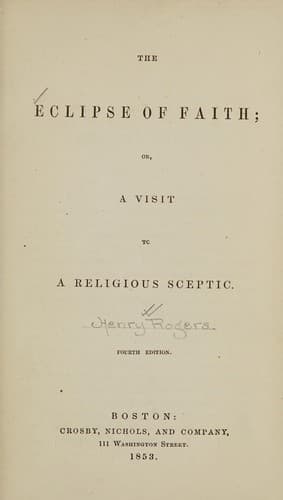
The Eclipse of Faith; Or, A Visit to a Religious ScepticRogers, Henry
Religion
The Eclipse of Faith; Or, A Visit to a Religious Sceptic
Rogers, Henry
Skepticism -- Controversial literature
"These are some of the perplexities," continued Harrington, "which,
as Theaetetus says, sometimes make 'My head dizzy,' when I revolve
the subject. Meantime, surely a nobler spectacle can hardly present
itself than our fairly abiding by our principle, amidst so many
plausible difficulties as assail it. I know no one principle in
theology or philosophy which has been so battered as that of Hume.
Not only Campbell, Paley, and so many more, confidently affirm errors
in it,--such as his assuming individual or general experience to
be universal; his quietly attributing to individual experience a belief
of facts which are believed by the vast mass of mankind on testimony,
and nothing else; his representing the experience of a man who says
he has seen a certain event as 'contrary' to the experience of him
who says he has not seen a similar one; his implying that no amount
of testimony can establish a miracle, which might compel us to believe
moral miracles to get rid of physical miracles; I say not only so, but
the most recent investigators of the theory of evidence cruelly abandon
him. The argument of Hume and Paley, says De Morgan, in his treatise
on Probabilities, (Encyclopaedia Metropolitana: Theory of
Probabilities, 182.) is a 'fallacy answered by fallacies,'--meaning
by this last that Paley had conceded to his opponent more than he ought
to have done. With similar vexatious opposition, Mr. J. S. Mill says,
that, to make any alleged fact contradictory to a law of causation,
'the allegation must be that this happened in the absence of any
adequate counteracting cause. Now, in the case of an alleged miracle,
the assertion is the exact opposite of this.' He says, 'that all which
Hume has made out is, that no evidence can prove a miracle to any one
who did not previously believe the existence of a being or beings
with supernatural power; or who believed himself to have full proof
that the character'(System of Logic, Vol. II. pp. 186, 187.) of such
being or beings is inconsistent with such an interference; that is,
the argument could have no force unless either a man believed there
were no God at all, or the objector happened to be something like a
God himself! And now, lastly, I have shown that the predicament of
Hume, and Voltaire, and Strauss, and you and myself (if consistent),
is just the reverse of that in which the argument from Transubstantiation
represents it. But never mind; so much more glory is due to us for
abiding by our principle. I begin almost to think that I am arriving
at that transcendental 'faith' which you admire so much, and which is
totally independent of logic and argument, and all 'intellectual
processes whatever.'"
____
July 23. I this day read to Mr. Fellowes the paper I had promised
a week or two before, and which I had entitled,
Public-domain text, read in full here on John Shaqi.
Reviews
Reviews
No reviews yet
Be the first to share your thoughts on this work.
Elsewhere in the archive
Join the Discussion
Join the discussion
Sign in to leave a comment or review.
Sign InorCreate an account