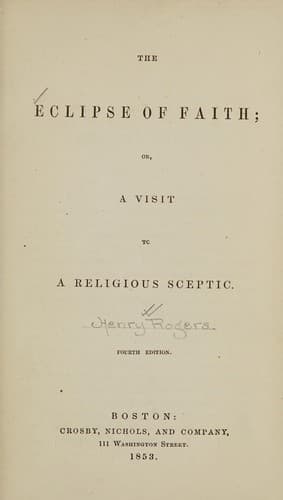
The Eclipse of Faith; Or, A Visit to a Religious ScepticRogers, Henry
Religion
The Eclipse of Faith; Or, A Visit to a Religious Sceptic
Rogers, Henry
Skepticism -- Controversial literature
"And as all mankind obviously act upon that same principle in most
cases, and we believe that it is part of the very uniformity in
question that human nature is radically the same in all ages and in
all countries, I think we ought to conclude that it is not you and
I only, but at all events the vast majority of mankind, who have
maintained the impossibility of miracles."
"We ought to be able to conclude so," said Fellowes, "but it is very
far from being the case. So far from it, that nothing can be plainer
than that miraculous legends have been most greedily taken up by the
vast majority of mankind, and have made a very common part of almost
every form of religion."
"Men do not then, it appears, in this instance, at all regard the
uniform tenor of their experience; so that it is a part of our uniform
experience, that mankind disregard and disbelieve the lessons of their
uniform experience. This is almost a miracle of itself; at all events,
a curious paradox; but one which we must not stay to examine: though
I confess it leads to one other humiliating conclusion,--a little
corollary, which I think it is not unimportant to mark; and that is,
that we can never expect these enlightened views of ours to spread
amongst the mass of mankind."
"Nay, I cannot agree with you. I hope far other wise, and far better
for the human race."
"But will the result not contradict your uniform experience, if your
hopes be realized? Is not your experience sufficiently long and
sufficiently varied to show that the belief of miracles and all sorts
of prodigies is the normal condition of mankind, and that it is only
a comparatively few who can discern that uniform experience justifies
man in believing that no miracle is possible? While it teaches us that
a miracle is impossible does it not also teach us that, though none
is possible, it is nevertheless impossible that they should not
be generally believed? Is not this taught us as plainly by our
uniform experience as any thing else? See how fairly Hume admits this
at the commencement of his Essay on Miracles. He says, 'I flatter
myself that I have discovered an argument which, if just, will, with
the wise and learned, be an everlasting check to all kinds of
superstitious delusion, and consequently will be useful as long as the
world endures. For so long, I presume, will the accounts of miracles
and prodigies be found in all histories, sacred and profane.' Thus
are we led to the conclusion, that, though miracles never can be real,
they will nevertheless be always believed; and that, though the truth
is with us, it never can be established in the minds of men in general.
And, my dear friend, let us be thankful that it never can; for if it
could, that fact would have proved the possibility of miracles by
contradicting one of those very deductions from uniform experience on
the validity of which their impossibility is demonstrated.
Public-domain text, read in full here on John Shaqi.
Reviews
Reviews
No reviews yet
Be the first to share your thoughts on this work.
Elsewhere in the archive
Join the Discussion
Join the discussion
Sign in to leave a comment or review.
Sign InorCreate an account