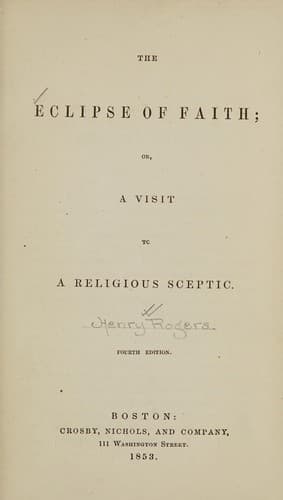
The Eclipse of Faith; Or, A Visit to a Religious ScepticRogers, Henry
Religion
The Eclipse of Faith; Or, A Visit to a Religious Sceptic
Rogers, Henry
Skepticism -- Controversial literature
Further; I contend that all the analogies from the fundamental laws
of the development of man's nature,--from a consideration of the
relations in which that nature stands to the external world,--from
the absolute dependence of the individual on external culture, and
that of the whole species on its historic development,--are all in
favor of the notion both of the possibility and utility of an external
revelation, and even in favor of that particular form of it which
Mr. Newman and you so contemptuously call a "book" revelation.
I. I argue from all the analogies of the fundamental laws of the
development of the human mind. Nor do I fear to apply the reasoning
even to the cases in which it has been so confidently asserted that
there can be no revelation, on the fallacious ground that a
revelation "of spiritual and moral truth" presupposes in man certain
principles to which it appeals. To possess certain faculties for the
appreciation of spiritual and moral truth is one thing; to acquire
the conscious possession of that truth is another; the former fact
would not make an external revelation superfluous, or an empty
name. Every thing in the process of the mind's development goes to
show, that, whatever its capacities, tendencies, faculties,
"potentialities," (call them what you will,) a certain external
influence is necessary to awaken its dormant life; to turn a
"potentiality" into an "energy "; to transform a dim inkling of a
truth into an intelligent, vital, conscious recognition of it.
Nor is this law confined to mind alone; all nature attests its
presence. All effects are the result of properties or susceptibilities
in one thing, solicited by external contact with those of others.
The fire no doubt may smoulder in the dull and languid embers; it
is when the external breeze sweeps over them, that they begin to
sparkle and glow, and vindicate the vital element they contain. The
diamond in the mine has the same internal properties in the darkness
as in the light; it is not till the sun shines upon it, that it
flashes on the eye its splendor. Look at a flower of any particular
species; we see that, as it is developed in connection with a variety
of external influences,--as it comes successively under the action
of the sun, rain, dew, soil,--it expands in a particular manner, and
in that only. It exhibits a certain configuration of parts, a certain
form of leaf, a certain color, fragrance, and no other. We do not doubt,
on the one hand, that without the "skyey influences" these things would
never have been; nor, on the other; that the flower assumes this form
of development, and this alone, in virtue of its internal structure and
organization. But both sets of conditions must conspire in the result.
Public-domain text, read in full here on John Shaqi.
Reviews
Reviews
No reviews yet
Be the first to share your thoughts on this work.
Elsewhere in the archive
Join the Discussion
Join the discussion
Sign in to leave a comment or review.
Sign InorCreate an account