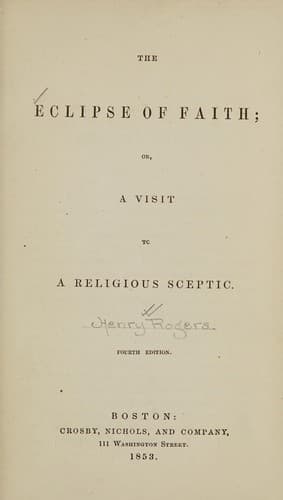
The Eclipse of Faith; Or, A Visit to a Religious ScepticRogers, Henry
Religion
The Eclipse of Faith; Or, A Visit to a Religious Sceptic
Rogers, Henry
Skepticism -- Controversial literature
It is much the same with the mind. That it possesses certain tendencies
and faculties, which, as it develops itself, will terminate in certain
ideas and sentiments, is admitted; but apart from certain external
conditions of development, those sentiments and ideas will, in effect,
never be formed,--the mind will be in perpetual slumber. Thus, in point
of fact, this controversy is connected ultimately with that ancient
dispute as to the origin, sources, and genesis of human knowledge and
sentiments. I shall simply take for granted that you are (as most
philosophers are) an advocate of innate capacities, but not of "innate
ideas"; of "innate susceptibilities," but not of "innate sentiments";
that is, I presume you do not contend that the mind possesses more than
the faculties--the laws of thought and feeling--which, under conditions
of development, actually give birth to thoughts and feelings. These
faculties and susceptibilities are, no doubt, congenital with the mind,
--or, rather, are the mind itself. But its actually manifested phenomena
wait the of the external; and they will be modified accordingly. It is
absolutely dependent on experience in this sense, that it is only as
it is operated upon by the outward world that the dormant faculties,
whatever they are, and whatever their nature, be they few or many,--
intellectual, moral, or spiritual,--are first awakened. If a mind were
created (it is, at least, a conceivable case) with all the avenues to
the external world closed,--in fact, we sometimes see approximations
to such a condition in certain unhappy individuals,--we do not doubt
such a mind, by the present laws of the human constitution, could not
possess any thoughts, feelings, emotions; in fact, could exhibit none
of the phenomena, spiritual, intellectual, moral, or sensational,
which diversify it. In proportion as we see human beings approach this
condition,--in fact, we sometimes see them approach it very nearly,--we
see the "potentialities" of the soul (I do not like the word, but it
expresses my meaning better than any other I know) held in abeyance,
and such an imperfectly awakened man does not, in some cases, manifest
the degree of sensibility or intelligence manifested in many animals.
If the seclusion from sense and experience be quite complete, the life
of such a soul would be wrapped up in the germ, and possess no more
consciousness than a vegetable.
It appears, then, that universally, however true it may be, and
doubtless is, that the laws of thought and feeling enable us to derive
from external influence what it alone would never give, yet that
influences an indispensable condition, as we are at present constituted,
of the development of any and of all our faculties.
Public-domain text, read in full here on John Shaqi.
Reviews
Reviews
No reviews yet
Be the first to share your thoughts on this work.
Elsewhere in the archive
Join the Discussion
Join the discussion
Sign in to leave a comment or review.
Sign InorCreate an account