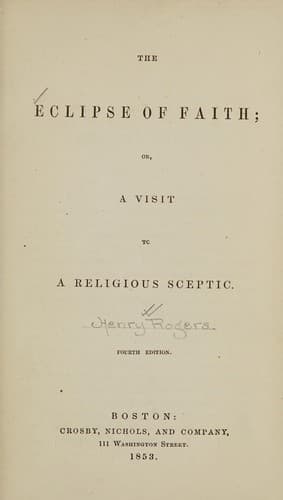
The Eclipse of Faith; Or, A Visit to a Religious ScepticRogers, Henry
Religion
The Eclipse of Faith; Or, A Visit to a Religious Sceptic
Rogers, Henry
Skepticism -- Controversial literature
Nor, surely, is there much presumption in supposing that the appropriate
influences of such an instrumentality may be brought to bear upon us
with infinite advantage by Him who alone possesses perfect access to
all the avenues of our spirits; a perfect mastery of our whole nature;
of intellect, imagination, and conscience of those laws of association
and emotion which He himself has framed. If Shakspeare and Milton can
daily exercise over myriads of minds an ascendency which makes their
admirers speak of them almost with the "Bibliolatry" with which Mr.
Newman makes Christian speak of the Bible, I apprehend God could
construct a "book," even though it told man nothing which was strictly
a revelation, which might be of infinite value to him; simply from
the fact that the modes in which truths operate upon us, and by which
our faculties are educated to their perfection, are scarcely less
important than either the truths or the faculties themselves.
But I need say the less upon this point, inasmuch as Mr. Newman has
spoken of the New Testament, and its influence over his mental history,
in terms which conclusively show that, if it be not a "revelation,"
ample space is left for such a divinely constructed book, if God were
pleased to give one.
"There is no book in all the world," says he, "which I love and esteem
so much as the New Testament, with the devotional parts of the Old.
There is none which I know so intimately, the very words of which
dwell close to me in my most sacred thoughts, none for which I so
thank God, none on which my soul and heart have been to so great an
extent moulded. In my early boyhood, it was my private delight and
daily companion; and to it I owe the best part of whatever wisdom
there is in my manhood." (Soul, pp. 241, 242.)
I only doubt whether even this testimony, strong as it is, fully
represents the power which the Book has had in modifying his interior
life, though he would now fain renounce its proper authority; whether
it has not had more to do than he thinks in originating his
conception of such "moral and spiritual" truth as he still recognizes.
Its very language comes so spontaneously to his lips, that his dialect
of "spiritualism" is one continued plagiarism from David and Isaiah,
Paul and Christ. Nay, I may well be doubted whether the entire substance
of his spiritual theory be any thing else than a distorted and mutilated
Christianity.
Public-domain text, read in full here on John Shaqi.
Reviews
Reviews
No reviews yet
Be the first to share your thoughts on this work.
Elsewhere in the archive
Join the Discussion
Join the discussion
Sign in to leave a comment or review.
Sign InorCreate an account