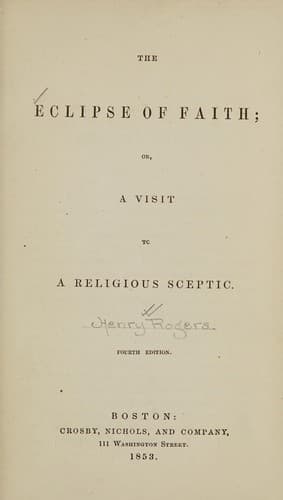
The Eclipse of Faith; Or, A Visit to a Religious ScepticRogers, Henry
Religion
The Eclipse of Faith; Or, A Visit to a Religious Sceptic
Rogers, Henry
Skepticism -- Controversial literature
Some of the previous observations apply to the possibility and utility
of a divinely originated statement of "ethical truth"; nor will they
be neutralized by an objection which Mr. Newman is fond of urging,
--namely, that a book cannot express (as it is freely acknowledged
no book can) the limitations with which maxims of critical truth are
to be received and applied; that all it can do is to give general
principles, and leave them to be applied by the individual reason and
conscience. Such reasoning is refuted by fact. The same thing precisely
is done, and necessarily done, in every department in which men attempt
to convey instruction in any particular art or method. It is thus with
the general principles of mechanics, of law, of medicine. Yet men never
entertain a notion that the collection and inculcation of such maxims are
of no use, or of little, merely because they must be intelligently
modified and not blindly applied in action. If indeed there were any
force in the objection, it would put an end to all instruction,--that
of Mr. Newman's "spiritual faculty" amongst the rest, for that too can
only prompt us by general impulses, and leaves us in the same ignorance
and perplexity how far we are to obey them. That is still to be
otherwise determined. The genuine result of such reasoning, if it were
acted upon, would be that we need never, in any science or art whatever,
trouble ourselves to enunciate any general principle or maxim, because
perfectly useless! Similarly, we need never inculcate on children the
duty of obeying their honoring their superiors, of being frugal or
diligent, humble or aspiring, the particular circumstances and
limitations in which they are to be applied being indeterminate! But
is not the experience of every day and of all the world against it? Is
not the early and sedulous inculcation of just maxims of duty fell
to be a great auxiliary to its performance in the circumstances in
which it is necessary to apply them? Is not the possession of a general
rule, with the advantages of a clear and concise expression,--in the
form of familiar proverbs, or embodied in powerful imagery,--a potent
suggestive to the mind; not only whispering of duty, but, by perpetual
recurrence, aiding the habit of attending to it? Is not the early and
earnest iteration of such sententious wisdom in the ears of the young,
--the honor which has been paid to sages who have elicited it, or
felicitously expressed it,--the care with which these treasures of
moral wisdom have been garnered up,--the perpetual efforts to conjoin
elementary moral truth with the fancy and association,--is not all
this a standing testimony to a consciousness of the value of such
auxiliaries of virtue and duty? Is it not felt, that, however general
such truths may be, the very forms of expression,--the portable shape
in which the truth is presented,--have an immense value in relation
to practice? Admitting, therefore, as before,--but, as before, only
Public-domain text, read in full here on John Shaqi.
Reviews
Reviews
No reviews yet
Be the first to share your thoughts on this work.
Elsewhere in the archive
Join the Discussion
Join the discussion
Sign in to leave a comment or review.
Sign InorCreate an account