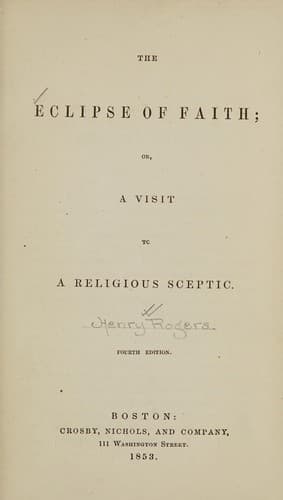
The Eclipse of Faith; Or, A Visit to a Religious ScepticRogers, Henry
Religion
The Eclipse of Faith; Or, A Visit to a Religious Sceptic
Rogers, Henry
Skepticism -- Controversial literature
not even possible, then, that this task should be performed by a book
like the Bible? and if such a book were given, would it not be,
I once more ask, in analogy with the fundamental laws of the soul's
development,--its uniform dependence on external influences for any
result, and the variable nature of that result, as the influence
itself is more or less appropriate? To affirm that each man at once,
by in internal illumination alone, attains a clear recognition of
even elementary "moral and spiritual truth" is to ignore the laws
according to which the soul's activity is developed, and to contradict
universal experience, which tells us that the great majority of mankind
are but in partial possession of this "spiritual and moral truth,"
and hold it for the most part in connection with the most prodigious
and pernicious errors.
You will perceive that I have here chosen to argue the question of
the possibility and utility of a "revelation" on your own grounds; but
recollect what I have said, that, in fact, the principal reasons for a
revelation would still remain in force, even if all you demand were
conceded. It is a point which I do not find that Mr. Newman's dictum
affects.
There may obviously be other facts and other truths as intimately
connected with man's destinies and happiness as the elementary truths
of religious and moral science; facts and truths which may be necessary
to give efficacy to mere elementary principles, and to supply motives
to the performance of moral precepts. And how ample in this respect
are man's necessities, and how large the field for a "divine revelation,"
if we content ourselves with such a meagre theology as that of Mr. Parker
and Mr. Newman, you see plainly enough in the questions asked by
Harrington! How many of Mr. Newman's and Mr. Parker's assumptions--the
moment they step beyond such "spiritual and moral truth" as is
"elementary" indeed--does Harrington declare that he finds unverified
by his own consciousness, and needing, if true, an authority to
confirm them far more weighty than theirs! As to the terms of access
to the Supreme Being,--his aspects towards man,--man's duties towards
him,--the future destinies, even the future existence, of the soul
(a point on which these writers are themselves divided),--the boasted
"progress" of the race, which they "prophesy," indeed, but without any
credentials of their mission,--you see how on all these points
Harrington maintains--and oh! how many, if the Bible be untrue, must
maintain with him--that he is in total darkness!
Public-domain text, read in full here on John Shaqi.
Reviews
Reviews
No reviews yet
Be the first to share your thoughts on this work.
Elsewhere in the archive
Join the Discussion
Join the discussion
Sign in to leave a comment or review.
Sign InorCreate an account