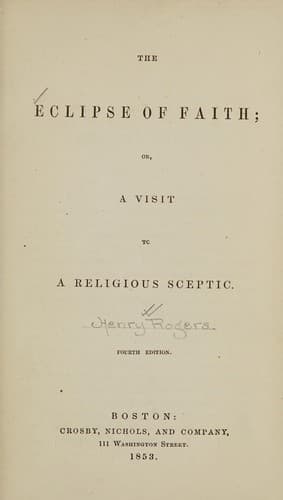
The Eclipse of Faith; Or, A Visit to a Religious ScepticRogers, Henry
Religion
The Eclipse of Faith; Or, A Visit to a Religious Sceptic
Rogers, Henry
Skepticism -- Controversial literature
conceding it for argument's sake (for the limits of variation, even
as regards the elementary truths of morals, are, as experience shows,
very wide),--that each man in some shape could anticipate for himself
the more important ethical truth, there would be yet ample scope left
for the utility of a divinely constructed instrument for its exhibition
and enforcement, in perfect harmony with the modes in which it is
actually exhibited and enforced by man, in close analogy with the
form in which he attempts the same task, whenever he teaches any
practical art or method whatever.
Only may it not be again presumed here, that He who knows perfectly
"what is in man" would be able to perform the work with
correspondent perfection? Whether He has performed it in the Bible
or not, that book does, at all events, contain not merely a larger
portion of pure ethical truth than any other in the world, but ethical
truth expressed and exhibited (as Mr. Newman himself, and most other
persons, would admit) in modes incomparably better adapted than in
any other book to lay hold of the memory, the imagination, the
conscience, and the heart.
Even then, if we conceded that elementary "spiritual and moral truth"
is not only congruous to man's faculties, but in some shape universally
recognized and possessed, it might yet be contended, from the manner
in which such truth is dependent for its power and vitality on the
forms in which it comes in contact with the human spirit and stimulates
it, that ample space is left for such a divine instrument as the Bible;
and that it would be in perfect conformity with the laws of our nature,
--in analogy with the known modes in which external aids give efficacy
to such truth. At the same time, be pleased once more to remember, that
I concede so much only for argument's sake; I contend that in the
stricter sense, without some external aid,--and the Bible may be at
least as effectual,--the religious faculty will not expand at all; and
that, even where there are these indispensable external influences,
the recognition of the truth is obscure or bright, as those influences
vary in their degrees of appropriateness. Where they are rude and
imperfect, (as amongst barbarous nations) we have the spectacle of a
soul which struggles towards the light, like a plant to which but
small portion of the sun's rays is admitted; it depends on the free
admission of the light whether or not it shall arrive at its full
development,--its beauty, its fragrance, and its color. The most that
merely human culture can promise, even under the most favorable
circumstances, (witness ancient Greece!) is that men, in some few
favored instances, may possibly attain those truths which it may be
admitted are congenital to the soul, and easily recognized when once
propounded but which, in fact, few men, by nature's sole teaching,
ever do clearly attain. It is infinitely important that the path,
dimly explored by sages alone, should be thrown open to mankind. Is it
Public-domain text, read in full here on John Shaqi.
Reviews
Reviews
No reviews yet
Be the first to share your thoughts on this work.
Elsewhere in the archive
Join the Discussion
Join the discussion
Sign in to leave a comment or review.
Sign InorCreate an account