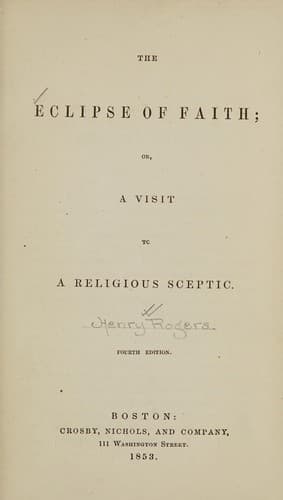
The Eclipse of Faith; Or, A Visit to a Religious ScepticRogers, Henry
Religion
The Eclipse of Faith; Or, A Visit to a Religious Sceptic
Rogers, Henry
Skepticism -- Controversial literature
To apply these observations to my special object. To one who attentively
studies man's immaterial anatomy, much the same complexity is, I think,
apparent; the philosopher is too apt to assume it to be much more simple
than it is. It is the very error, as I conceive, into which some of
you modern "spiritualists" fall when considering the phenomena of our
religious nature. You do not sufficiently regard man as a complicated
unity; you represent, if you do not suppose, the several capacities
of his nature,--the different parts of it, sensational, emotional,
intellectual, moral, spiritual,--as set off from one another by a
sharper boundary line than nature acknowledges. They all work for
immediate ends, indeed; but they all also work for, with, and upon
each other, for other ends than their own. Yet, as they all exist in
one indivisible mind, or rather constitute it, they form one most
intricate machine: and it can rarely happen that the particular
phenomena of our interior nature we happen to be investigating do
not involve many others. Throughout his book on the "Soul," we find
Mr. Newman employing expressions (though I admit there are others
which contradict them) which imply that the phenomena of religion, of
what he calls "spiritual insight," may be viewed in clearer distinction
from those of the intellect, than, as I conceive, they ever can be;
and that a much clearer separation can be effected between them than
nature has made possible. To hear him sometimes speak, one would
imagine that the logical, the moral, and the spiritual are held together
by no vital bond of connection; nay, from some expressions, one would
think that the "logical" faculty had nothing to do with religion, if
it is not to be supposed rather to stand in the way of it; that the
"intellect" and the "spiritual faculty" may each retire to its "vacant
interlunar cave," and never trouble its head about what the other
is doing. Thus he says in one place, "All the grounds of Belief
proposed to the mere understanding have nothing to do with Faith at
all." (Soul, p. 223.) In another, "The processes of thought have nothing
to quicken the conscience or affect the soul." (ibid. p. 245) "How,
then, can the state of the soul be tested by the conclusion to
which the intellect is led?" (ibid. p. 245.) And accordingly you see
he everywhere affirms that we ought not to have any better or worse
opinion of any man for his "intellectual creed"; and that "religious
progress" cannot be "anticipated" till intellectual "creeds
are destroyed." (Phases, p. 222.)
Public-domain text, read in full here on John Shaqi.
Reviews
Reviews
No reviews yet
Be the first to share your thoughts on this work.
Elsewhere in the archive
Join the Discussion
Join the discussion
Sign in to leave a comment or review.
Sign InorCreate an account