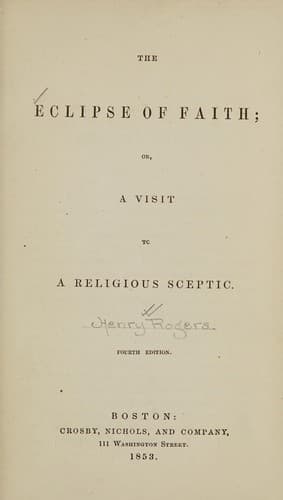
The Eclipse of Faith; Or, A Visit to a Religious ScepticRogers, Henry
Religion
The Eclipse of Faith; Or, A Visit to a Religious Sceptic
Rogers, Henry
Skepticism -- Controversial literature
Here one would imagine that the intellectual, moral, and spiritual
had even less to do with the production of each other's results
than matter and mind reciprocally have with theirs. These last,
we see, in a thousand cases act and react upon one another; and
modify each other's peculiar products and operations in a most
important manner. How much more reasonably may we infer that the
elementary faculties of the same indivisible mind will not discharge
their functions without important reciprocal action; that in no case
can we have the process pure and simple as the result of the
operation of a single faculty!
If it were not so, I see not how we are to perform any of the functions
of a spiritual nature, even as defined by you and your favorite writers;
unless, indeed, you would equip the soul with an entire Sunday suit
of separate capacities of reasoning, remembering, imagining, hoping,
rejoicing, and so on, to be expressly used by the "soul" alone when
engaged in her spiritual functions; quite different from that old,
threadbare, much-worn suit of faculties, having similar functions
indeed, but exercised on other objects.
What can be more obvious (and it must be admitted that the most
fanatical "spiritualist" employs expressions, and, what is more, uses
methods, which imply it) than that, whether we have a distinct
religious faculty or whether it be the result of the action of many
faculties, the functions of our "spiritual" nature are performed
by the instrumentality, and involve the intervention, of the very
same much-abused faculties which enable us to perform any other
function. It is one and the same indivisible mind which is the subject
of religious thought and emotion, and of any other thought and
emotion. Religious truth, like any other truth, is embraced by the
understanding--as indeed it would be a queer kind of truth that is
not is stated in propositions, yields inferences, is adorned by
eloquence is illustrated by the imagination, and is thus, as well
from its intrinsic claims, rendered powerful over the emotions, the
affections, and the will. In brief, when the soul apprehends, reasons,
remembers, rejoices, hopes, fears, spiritually, it surely does not
perform these functions by totally different faculties from these
by which similar things are done on other occasions. All experience
and consciousness are against the supposition. In religion, men's
minds are employed on more sublime and elevated themes indeed, but
the operations themselves are essentially of the same nature as in
other cases. Hence we see the dependence of the true development of
religion on the just and harmonious action of all our faculties.
They march together; and it is the glorious prerogative of true
religion that it makes them do so; that all the elements of our
nature, being indissolubly connected, and perpetually acting and
reacting on one another, should aid one another and attain a more
just conjoint action.
Public-domain text, read in full here on John Shaqi.
Reviews
Reviews
No reviews yet
Be the first to share your thoughts on this work.
Elsewhere in the archive
Join the Discussion
Join the discussion
Sign in to leave a comment or review.
Sign InorCreate an account