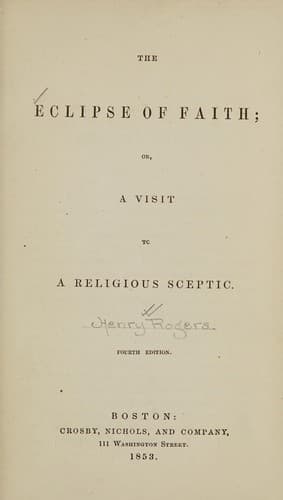
The Eclipse of Faith; Or, A Visit to a Religious ScepticRogers, Henry
Religion
The Eclipse of Faith; Or, A Visit to a Religious Sceptic
Rogers, Henry
Skepticism -- Controversial literature
If there be acceptable faith, it presupposes
belief of the truth, as well as love of it in the heart; if there
be holy habit, it implies just knowledge of duty; if there be
spiritual emotion awakened, it will still be in accordance with
the laws which ordinarily produce it; that is, because that which
should produce it is perceived by the senses or the intellect, is
recalled by the memory, is vivified by the imagination. If faith
and hope and love often kindle into activity, and hallow these
instruments by which and through which they act, it is not the less
true, that, apart from these,--as constituting the same indivisible
mind--faith and hope and love cannot exist: and not only so; but
when faith is languid, and hope faint, and love expiring, these
faculties themselves shall often in their turn initiate the process
which shall revive them all; some outward object, some incident of
life, some "magic word," some glorious image, some stalwart truth,
suddenly and energetically stated, shall, through the medium of the
senses, the imagination, or the intellect, set the soul once more
in a blaze, and revive the emotions which it is at other times only
their office to express. A sanctified intellect, a hallowed
imagination, devout affections, have a reciprocal tendency to
stimulate each other. In whatever faculty of our nature the stimulus
may be felt,--in the intellect or the imagination,--it is thence
propagated through the mysterious net-work of the soul to the emotions,
the affections, the conscience, the will: or, conversely, these last
may commence the movement and propagate it in reverse order. Each
may become in turn a centre of influence; but so indivisible is the
soul and mind of man, so indissolubly bound together the elements
which constitute them, that the influence once commenced never stops
where it began, but acts upon them all. The ripple, as that of a
stone dropped into still water, no matter where, may be fainter and
fainter the farther from the spot where the commotion began, but it
will stop only with the bank. Ordinarily many functions of the mind
are involved in each, and sometimes all in one.
____
July 24. Yesterday, a somewhat interesting conversation took place
between Harrington and Edward Robinson, a youth at college, a friend
of George Fellowes's family. He is a devout admirer of Strauss, and
thinks that writer has completely destroyed the historical character
of the Gospels. I was, as usual, struck with the candor and logical
consistency with which our sceptic was disposed to regard the subject.
"You have Lingard and Macaulay here, I see," said young Robinson. "I
need hardly ask, I think, which you find the most pleasant reading?"
"You need not, indeed," cried Harrington. "Mr. Macaulay is so superior
to the Roman Catholic historian (though his merits are great too) in
genius, in consequence, in variety and amplitude of knowledge, in
imagination, in style, that there is no comparison between them."
Public-domain text, read in full here on John Shaqi.
Reviews
Reviews
No reviews yet
Be the first to share your thoughts on this work.
Elsewhere in the archive
Join the Discussion
Join the discussion
Sign in to leave a comment or review.
Sign InorCreate an account