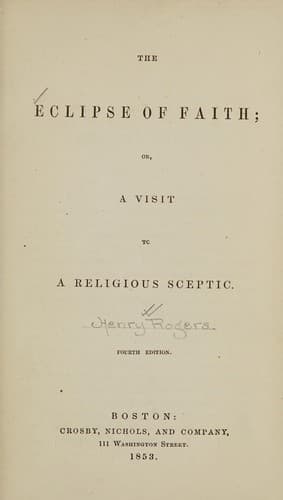
The Eclipse of Faith; Or, A Visit to a Religious ScepticRogers, Henry
Religion
The Eclipse of Faith; Or, A Visit to a Religious Sceptic
Rogers, Henry
Skepticism -- Controversial literature
"I think nothing, because, as I told Fellowes the other day, I am
half inclined to doubt whether I doubt whether a miracle is possible
or not, like a genuine sceptic as I am. And this doubt, you see,
even of a doubt, makes me cautious. But to resume. If that principle
be sound, it seems much more natural to adhere to it than to attack
the Gospels as history. Strauss, however, has thought otherwise; and
while he has left this main dictum unproved,--nay, has not even
attempted a proof of it,--he has endeavored to shake the historic
character of these records, treating them like any other records. I
say, therefore, that to adduce the circumstance that the narrative is
miraculous, is nothing to the purpose, until the impossibility of
miracles is proved; and then, when this is proved, it is unnecessary
to adduce the discrepancies. If on the other hand, a man has no
difficulty (as the Christian, for example) in believing miracles to
be possible, and that they have really occurred, Strauss's argument,
as I have said, is evaded; and the seeming discrepancies can do no
more against the credibility of the New Testament history, than equal
discrepancies can prove against any other document. I will, if possible,
make my meaning plain by yet another example. Let us suppose some Walter
Scott had compiled some purely fictitious history, professedly laid in
the Middle Ages (and surely even miraculous occurrences cannot be more
unreal than these products of sheer imagination); and suppose some
critic had engaged to prove it fiction from internal evidence supplied
by contradictions and discrepancies, and so on, would you not think it
strange if he were to enforce that argument by saying, 'And besides
all this, what is more suspicious is, that they occur in a work
of imagination!' Would you not say, 'Learned sir, we humbly thought
this was the point you were engaged in making out? Is it not to assume
the very point in debate? And if it be true, would it not be better
to stop there at once, instead of taking us so circuitous a road to
the same result, which we perceive you had already reached beforehand?
Are you not a little like that worthy Mayor who told Henri Quatre
that he had nineteen good reasons for omitting to fire a salute on
his Majesty's arrival; the first of which was, that he had no artillery;
whereupon his Majesty graciously told him that he might spare the
remaining eighteen?' So I should say in the supposed case.--To return,
then: you must, if you would consider the validity of Strauss's argument,
lay aside the miraculous objection, which must be decided on quite
different grounds, and which, in fact, if valid, settles the
controversy without his critical aid. All who read Strauss's book
either believe that miracles are impossible, or not; the former need
not his criticisms,--they have already arrived at the result by a
shorter road; the latter can only reject the history by supposing the
discrepancies in it, as history, justify them.
Public-domain text, read in full here on John Shaqi.
Reviews
Reviews
No reviews yet
Be the first to share your thoughts on this work.
Elsewhere in the archive
Join the Discussion
Join the discussion
Sign in to leave a comment or review.
Sign InorCreate an account