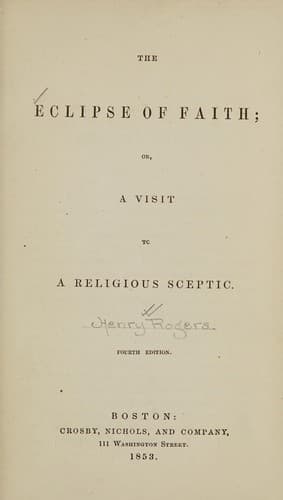
The Eclipse of Faith; Or, A Visit to a Religious ScepticRogers, Henry
Religion
The Eclipse of Faith; Or, A Visit to a Religious Sceptic
Rogers, Henry
Skepticism -- Controversial literature
I ask you, then,
supposing you one who, like the Christian, believes miracles possible,
whether these historic discrepancies would justify you in saying that
the New Testament records, considered simply as history, no longer
deserve credit, and that you are left in absolute ignorance how much
of them, or whether any part, is to be received,--ay or no?"
"Well, then, I should say that Strauss has shown that the history, as
history, is to be rejected."
"Very well; only then do not be surprised that, in virtue of such
conclusions, I doubt whether you ought not to push the principle a
little further, and contend that, as there are no writings in the
world which to bear more marks of historic sincerity and
trustworthiness, and certainly none of any magnitude or variety
in which far greater discrepancies are not to be founds, it is
doubtful whether we can receive any thing as absolutely veritable
history; and that the Book of Genesis, and Gospel of Luke, and
History of Lingard, and History of Hume, are alike covered with a
mist of sceptical obscurity."
"But really, Mr. Harrington, this is absurd and preposterous!"
"It may be so; but you must prove it, and not simply content
yourself with affirming it. I am, at all events, more consistent than
you, who tell the man who does not see your a priori objection to
the belief of miracles, that a history which certainly contains as
many marks of historic veracity as any history in the world, and
discrepancies neither greater nor more numerous, must be reduced
(ninety-nine hundredths of it) to myth on account of those
discrepancies, while the others may still legitimate their claims
to be considered as genuine history! Your only escape, as I conceive,
from this dilemma, is, by saying that the marks of historic truth
in the New Testament, looked at as mere history, are not so great as
those of other histories, or that the discrepancies are greater; and
I think even you will not venture to assert that. But if you do, and
choose to put it on that issue, I shall be most happy to try the
criterion by examining Luke and Paul, Matthew and Mark, on the one
side; and Clarendon and May, or Hume, Lingard, and Macaulay, on the
other; or, if you prefer them, Livy and Polybius, or Tacitus
and Josephus."
"But I have bethought me of another answer," said Robinson. "Suppose
the sacred writers affirm that every syllable they utter is infallibly
true, being inspired?"
Public-domain text, read in full here on John Shaqi.
Reviews
Reviews
No reviews yet
Be the first to share your thoughts on this work.
Elsewhere in the archive
Join the Discussion
Join the discussion
Sign in to leave a comment or review.
Sign InorCreate an account