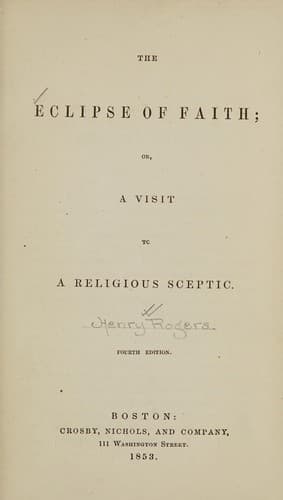
The Eclipse of Faith; Or, A Visit to a Religious ScepticRogers, Henry
Religion
The Eclipse of Faith; Or, A Visit to a Religious Sceptic
Rogers, Henry
Skepticism -- Controversial literature
"Why, then," said Harrington, "first, you must find such a passage,
which many say you cannot; secondly, you must find one which says
that every syllable would remain always infallibly true, in spite
of all errors of transcription and corruptions of time, otherwise
your discrepancies will not touch the writers; and lastly, it does
not affect my argument whether you find any such absurdities or not,
since you and I would know what to say, though the Christian would not
like to say it; namely, that these writers were mistaken in the notion
of their plenary inspiration. It would still leave the mass of their
history to be dealt with like any other history. Now I want to know why,
if I reject the mass of that on the ground of certain discrepancies,
I must not reject the mass of this on the score of equal or greater."
After a few minutes Harrington turned to Fellowes and said,--"That in
relation to the bulk of mankind there can be no authentic history of
remote events plainly appears from a statement of Mr. Newman. He says,
you know, after having relinquished the investigation of the evidences
of Christianity, that he might have spared much weary thought and
useless labor, if, at an earlier time, this simple truth had been
pressed upon him, that since the 'poor and half-educated cannot
investigate historical and literary questions, therefore these questions
cannot constitute an essential part of religion.' You, if you recollect,
mentioned it to my uncle the other night; and, in spite of what he
replied, it does appear a weighty objection; on the other hand, if I
admit it to be conclusive, I seem to be driven to the most paradoxical
conclusions, at direct variance with the experience of all mankind,--at
least so they say. For why cannot an historical fact constitute part
of a religion?"
"Because, as Mr. Newman says, it is impossible that the bulk of people
call have any 'certainty in relation to such remote facts of history,"
said Fellowes.
"And, therefore, in relation to any other remote history; for if the
bulk of men cannot obtain certainty on, such historical questions,
neither can they obtain certainty on other historical questions."
"Perhaps not; but then what does it matter, in that case, whether they
can obtain certainty or not?"
"I am not talking--I am not thinking--as to whether it would matter or
not. I merely remark that, in relation to the generality of people,
at all events, they cannot obtain certainty on any remote historical
questions. Of course, with regard to ordinary history, it is neither
a man's duty, strictly speaking, to believe or disbelieve; and therefore
I said nothing about duty. But in neither the one case nor the other
is it possible for the bulk of mankind to obtain satisfaction, from a
personal investigation, as to the facts of remote history, or indeed
any history at all, except of a man's own life and that perhaps of
his own family, up to his father and down to his son! What do you say
to this,--yes or no?"
Public-domain text, read in full here on John Shaqi.
Reviews
Reviews
No reviews yet
Be the first to share your thoughts on this work.
Elsewhere in the archive
Join the Discussion
Join the discussion
Sign in to leave a comment or review.
Sign InorCreate an account