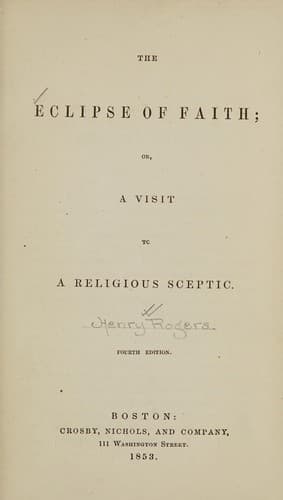
The Eclipse of Faith; Or, A Visit to a Religious ScepticRogers, Henry
Religion
The Eclipse of Faith; Or, A Visit to a Religious Sceptic
Rogers, Henry
Skepticism -- Controversial literature
"'That there may have been, and very probably was, some nucleus of
fact which may have served as a groundwork for these pseudo-historical
memorials, is not denied: but to regard that document of which it
is professedly a condensation as a genuine record of the period in
question, can only, we conceive, be the infelicity of an essentially
uncritical mind. Most evidently, whether we regard the known events and
relations of that age (as far as they have come down to us) or the
internal characteristics of the document itself, we discover
unequivocal traces of an unhistoric origin. Let us look at both these
sources of evidence in order. If we mistake not, the document, even
as it now stands, bears on its very front, that the original document,
so far from being a literal description of the events of the time to
which it professedly related, was allegorical, or at most historico-
allegorical, and most likely designed broadly to caricature and
satirize some perceived tendencies or conditions of the English
religious development in certain parties of that age. But whether it
be, or be not, reducible to the class of allegorieo-ecclesiastico-
political satire, certainly no person of critical discernment can for
a moment allow it to be a literal statement of historic events. And
first to look at the internal evidence.
"'Is it possible to overlook the singular character of the names
which everywhere meet us? They, in fact, tell their own tale, and
almost, as it were, proclaim of themselves that they are allegorical.
Wiseman, Newman (two of them, be it observed), Masterman, Philpotts,
Wilde. Who, that has been gifted with even a moderate share of
critical acumen, can fail to see that these are all fictitious names,
invented by the allegorist either to set forth certain qualities or
attributes of certain persons whose true names are concealed, or, as
I rather think, to embody certain tendencies of the times, or represent
certain party characteristics. Thus the name "Wiseman" is evidently
chosen to represent the proverbial craft which was attributed to the
Church of Rome; and Nicholas has also been chosen (as I apprehend)
for the purpose of indicating the sources whence that craft was derived.
In all probability the name was selected just in the same manner as
Bunyan in his immortal Pilgrim's Progress (which still delights the
world) has chosen "Worldly Wiseman" for one of his characters. It is
said that he was a Spaniard: but who so fit as a Spaniard to be
represented as the agent of the Holy See? while, as there never was
a Spaniard of that name, every one can see that historic probability
has not been regarded. The word "Newman" again (and observe the
significant fact that there were two of them) was, in all probability,
I may say certainly, designed to embody two opposite tendencies, both
of which, perhaps, claimed, in impatience of the effete humanity of
that age (a dead and stereotyped Protestantism), to introduce a new
order of things.
Public-domain text, read in full here on John Shaqi.
Reviews
Reviews
No reviews yet
Be the first to share your thoughts on this work.
Elsewhere in the archive
Join the Discussion
Join the discussion
Sign in to leave a comment or review.
Sign InorCreate an account