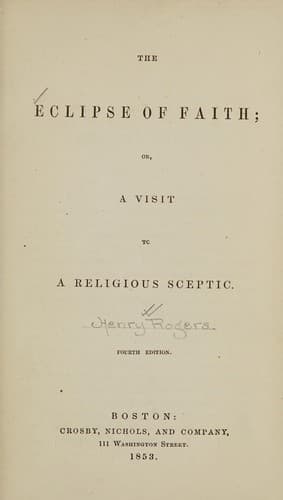
The Eclipse of Faith; Or, A Visit to a Religious ScepticRogers, Henry
Religion
The Eclipse of Faith; Or, A Visit to a Religious Sceptic
Rogers, Henry
Skepticism -- Controversial literature
These parties (if I may form a conjecture from the
document itself) were essaying to extricate the mind of the age
from the difficulties of its intellectual position; an age,
asserting inconsistently, on the one hand, the freedom of spiritual
life, and, on the other, claiming for the Bible an authorized
supremacy over all the phenomena of that spiritual life. One of these
parties sought to solve this difficulty by endeavoring to resuscitate
the spirit of the past; the other, by attempting to set human
intellect and consciousness free from the yoke of all external
authority. In all probability the names were suggested to the
somewhat profane allegorico-satitical writer by that text in the
English version, "Put on the Newman," the new man of the spirit.
We are almost driven to this interpretation, indeed, by the extreme
and ludicrous improbability of two men--brothers, brought up at
the same university--gradually receding, pari passu, from the same
point in opposite directions, to the uttermost extreme; one till
he had embraced the most puerile legends of the Middle Ages, the
other, till he had proceeded to open infidelity. Probably such a
curious coincidence of events was never heard of since the world
began; and this must, at all events, be rejected.
"'Similar observations apply to the name Masterman, which, in ancient
English, was applied to him who was not a "servant" or "journeyman,"
and is not unfitly used to indicate collectively the assemblage of
wealthy merchants who, like those of Tyre, were "princes"; as well
as to imply that the powerful class to which they belonged were the
"Mastermen" in the country, and, in fact, spoke in a potential voice
in all such crises as that supposed. It might also, perhaps, be
designed obliquely to intimate, that, 'whatever the clergy and the
theologians of different parties might wish to realize, it was,
after all, the powerful and independent class of the laity who were
the "mastermen," and would not succumb to any spiritual guides whatever,
even though called by the specious names of Wisemen and Newmen. The
mere singularity of the names alone ought to decide the point. And
what further confirms our view is, that it is impossible to point
out any Englishmen of any distinction who ever had any of these
names. Here we do not argue from conjecture, after merely looking
into the most recent biographical repertories (as, for example,
the "Bibliotheca Clarisimorum Virorum," in three hundred and fifty
volumes folio); for it is no argument that this meagre collection
makes no mention of any such names; since, in the successive
compilations of such works, (as the world grows older,) it has
been found necessary to extrude from time to time thousands of lesser
names, which had twinkled in preceding ages. But, deeply anxious to
establish truth, we have at infinite pains caused to be fished up,
from the depths of the archives of our national museums, very rare
Public-domain text, read in full here on John Shaqi.
Reviews
Reviews
No reviews yet
Be the first to share your thoughts on this work.
Elsewhere in the archive
Join the Discussion
Join the discussion
Sign in to leave a comment or review.
Sign InorCreate an account