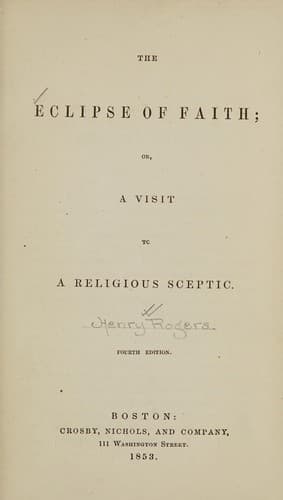
The Eclipse of Faith; Or, A Visit to a Religious ScepticRogers, Henry
Religion
The Eclipse of Faith; Or, A Visit to a Religious Sceptic
Rogers, Henry
Skepticism -- Controversial literature
"'But the internal evidence, conclusive as it is, is as nothing to
the external. If we examine the document by the light of the facts
which contemporary history supplies, nay, even by the probability or
otherwise of its own contents, we shah see the extreme absurdity of
supposing that the account from which it was borrowed was ever meant
to be a record of facts. We hesitate not to say, that the political
facts of which it makes mention are many of them in the highest degree
incredible. That there may have been a rebellion at Rome is very
possible; but assuredly the only nation in Europe, (if we except
England,) that was not likely to take the Pope's part against a
republican movement, or resent him on his throne, was the French.
To suppose them thus acting is contrary to all that we know of the
history of that nation, and of human nature. The traces of the terrible
revolutions which in that century, and at the close of the preceding
one, shook France again and again to her centre, and the outlines of
which still live in authentic history, all show the extent to which
infidelity and democratic violence prevailed in France; nay, we know
that during the dominion of the Emperor Napoleon, if we are to regard
his history as literally true, and not a collection of fables and
legends,* as some even of that age maintained, that great conqueror
arrested and imprisoned the Pope. That France should have undertaken
the task of subduing a republican movement, just when she had come
out of a similar revolution, or rather many such,--and of reseating
the Pope on his throne, when she had been more impatient of the
restraints of all religion than any other nation in Europe,--is
perfectly incredible! Not less improbable is it that, supposing (as
may perhaps be true) that there was a basis of fact in the asserted
rebellion of the Romans, and Pio Nono's restoration to his dominions
(though not by France, that the intelligent reader will on
politico-logical grounds pronounce impossible, but more probably by
the Spaniards),--yet can we suppose that a power which was always
celebrated for its astuteness and subtlety would choose that very
moment of humiliation and ignominy to rush into an act so audacious
as that of reestablishing the Romish hierarchy in England,--in a
nation by far the most powerful in the world at that time,--a nation
which, if it had pleased, could have blown Rome into the air in
three months? It must needs have strengthened a thousand-fold the
strong antipathies of the English to the See of Rome. It would,
indeed, have justified that storm of indignation with which it is
said to have been met.
____
* Dr. Dickkopf may be here supposed to refer to the "Historic Doubts"
of Archbishop Whately, which may well deceive even more astute
critics.--Ed.
____
Public-domain text, read in full here on John Shaqi.
Reviews
Reviews
No reviews yet
Be the first to share your thoughts on this work.
Elsewhere in the archive
Join the Discussion
Join the discussion
Sign in to leave a comment or review.
Sign InorCreate an account