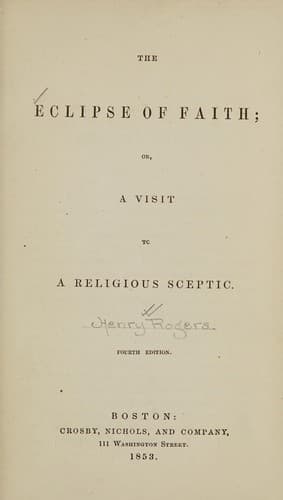
The Eclipse of Faith; Or, A Visit to a Religious ScepticRogers, Henry
Religion
The Eclipse of Faith; Or, A Visit to a Religious Sceptic
Rogers, Henry
Skepticism -- Controversial literature
reprints of some of the works of the age nearest that in which these
events are said to have occurred, and in none of these works is there
an individual mentioned of the name of Newman or Masterman, and
only one comparatively obscure person of the name of Wiseman,--a
presumptive proof that they were fictitious names. Is it possible
that these curious and varied coincidences can be the mere effect
of chance?'
"I shall spare you," said Harrington, "Dr. Dickkopf's learned
etymological disquisitions on the names Wilde and Philpotts, which,
aided by the imputed 'rashness' of the one, and the 'intoxicated zeal'
of the other, he clearly demonstrated to be fictitious.
"After which, I will suppose him to proceed thus:--
'We presume we have said enough to convince any acute and candid mind
of the extreme improbability of the document being designed to convey
to posterity a literal statement of facts; not that we for a moment
think it necessary to suppose that any evil design actuated the writer,
whoever he might be. It was most likely intended, as we have already
said, to be an allegorico-political caricature of certain events which
did undeniably occur, and which formed a slender basis of historic
fact on which to found it.
"'Nor is the particularity of some of the dates and alleged
circumstances of much weight in our judgment. He must be a miserable
inventor of fiction indeed, who cannot clothe a narrative in some
verisimilitude of this kind. It is said, that the historian makes a
seeming reference to those who were living at the very time.
"Some," he says, "still survive." But who does not see that the
word "survive" may refer to the accounts (which he, it appears,
knew little how to interpret), not the persons; though, be it observed,
that on such a supposition he does not vouch for having seen them,
and may have spoken merely from report. This very clause, too, has
undeniably much the appearance of an interpolation. There are many
other little circumstances, which, to those who have been accustomed
to detect unhistoric characteristics in ancient documents, and to
draw a sharp line between the mythic or allegoric and the historic,
sufficiently proclaim the origin of this supposed narrative of facts.
Public-domain text, read in full here on John Shaqi.
Reviews
Reviews
No reviews yet
Be the first to share your thoughts on this work.
Elsewhere in the archive
Join the Discussion
Join the discussion
Sign in to leave a comment or review.
Sign InorCreate an account