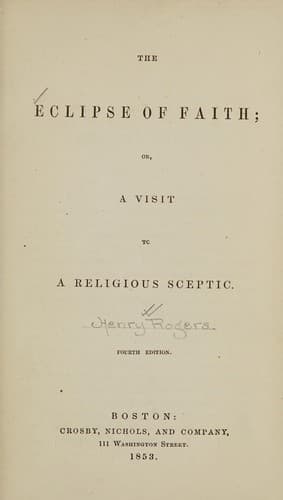
The Eclipse of Faith; Or, A Visit to a Religious ScepticRogers, Henry
Religion
The Eclipse of Faith; Or, A Visit to a Religious Sceptic
Rogers, Henry
Skepticism -- Controversial literature
"'It is superfluous to point out the absurdity of supposing a Cardinal
of the Romish Church lecturing the people of England on "the claims of
religious liberty"; or so great a nation, in such a paroxysm, spending
many months in the concoction of a measure confessed to be a feeble one,
and suffered to be broken with impunity!
"'But, lastly, my laborious researches have led to the important
discovery, that, in this very year of pretended hot commotion,
England--in peace with all the world, profound peace within and
profound peace without--celebrated a sort of jubilee of the nations,
in a vast building of glass (wonderful for those times), called the
Great Exhibition, to which every country had contributed specimens
of the comparatively rude manufacture--of that rude age! London was
filled with foreigners from all parts of the earth; the whole kingdom
was in a commotion, indeed, but a commotion of hospitable festivity,
in which it shook hands with all the world!
This is a piece of positive evidence which ought to settle the whole
matter. In short, the external and internal evidence alike warrants
us in rejecting this absurd story as utterly incredible.'"
"Upon my word," said young Robinson, "you have said more than I thought
you could have said on such a theme. I really almost doubt whether
Dr. Dickkopf has not the best of it, and whether we ought not to
agree that the 'Papal Aggression' is a sheer delusion."
"O," said Harrington, "I have mot given you half the arguments by
which an historian, eighteen hundred years hence, might prove that
what has actually occurred never could have occurred, and that what
has not occurred must, in the very nature of things, have occurred,
by a necessity alike political, historical, ethical, logical, and
psychological. And no doubt Dr. Dickkopf is right on the principles
on which acute critics may argue; that is, the assumption that certain
probabilities will justify conclusions on such subjects. One might
naturally have supposed the Pope to have been more politic than to
take this step,--the French more consistent than to suppress the
Republican movement of Italy,--the English less moderate in
expressing their indignation,--and certainly that there would
never have been such an array of odd names to garnish one brief document.
And now, I bethink me, it is far from impossible that some Dr.
Dickkopf may even apply to Strauss's Leben Jesu, and Dr. Whately's
'Historic Doubts' similar reasoning, to prove that the first was
elaborate irony, and the second a sincere expression of scepticism."
"How can that be?"
Public-domain text, read in full here on John Shaqi.
Reviews
Reviews
No reviews yet
Be the first to share your thoughts on this work.
Elsewhere in the archive
Join the Discussion
Join the discussion
Sign in to leave a comment or review.
Sign InorCreate an account