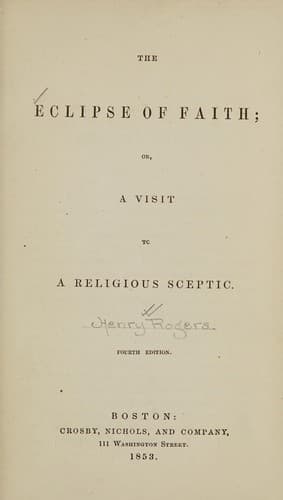
The Eclipse of Faith; Or, A Visit to a Religious ScepticRogers, Henry
Religion
The Eclipse of Faith; Or, A Visit to a Religious Sceptic
Rogers, Henry
Skepticism -- Controversial literature
"Thus: he will prove that the age was remarkably fond of such species
of ironical literature. As Strauss, in his preface, has expressly
admitted (though we all know what he means) that Christianity is true,
and has suggested an unimaginably absurd hypothesis as to its true
import, founded on the principles of the Hegelian philosophy, the
learned Dr. Dickkopf will say, that no one who so spoke of Christianity
could have intended seriously to discredit it, and yet certainly could
not possibly believe the absurd theory of it concocted out of German
philosophy; ergo, that we must regard the whole book as a piece of
prolonged irony,--a little too characteristic of German pedantry, it
is true, but sincerely designed to expose that extravagance of historic
criticism and Biblical exegesis which had so distinguished the
author's countrymen, by which Homer had been annihilated, a great
part of ancient history rendered doubtful, and the Bible turned into
a riddle-book; that this hypothesis is confirmed by the space which
Strauss gives to the exposure of the absurdities of the Rationalists,
which, in fact, occupies at least half his work. Dr. D. will even
very likely prove that Strauss himself is a fictitious name; Strauss,
in the German, meaning an ostrich, which, according to the proverb,
can digest any thing. On the other hand, as he will be able to show
that Strauss's work is a piece of prolonged irony, he will very likely
show that Whately's 'Historic Doubts' may be a sincere expression of
opinion (which, in fact, many have even in our day wisely believed
it to be), and he will argue it with a gravity worthy of one of the
commentators who interpret the irony of Socrates literally; he will
prove it from the air of sobriety and sincerity which pervades the
pamphlet. Nay, for aught I know, he may show that there was an
'historic place' for such a piece in the undoubted myths to which
the wondrous achievements of Napoleon had given rise; he will say that
these had produced a natural feeling of scepticism as to the greater
part of the facts, though he will think Dr. Whately has gone a little
too far in doubting his very existence; there being sufficient evidence
that such a man as Napoleon existed, though the world really knows
little more about him than about Semitamis or Genghis Khan!"
"Well," said I, "having proved that Dr. Strauss's work is irony, and
Whately's brochure a sincere expression of opinion, it would be hard
for even Dr. Dickkopf to go further. But, seriously, it is no
laughing matter. This is a strange power the future historian has
over us."
Public-domain text, read in full here on John Shaqi.
Reviews
Reviews
No reviews yet
Be the first to share your thoughts on this work.
Elsewhere in the archive
Join the Discussion
Join the discussion
Sign in to leave a comment or review.
Sign InorCreate an account