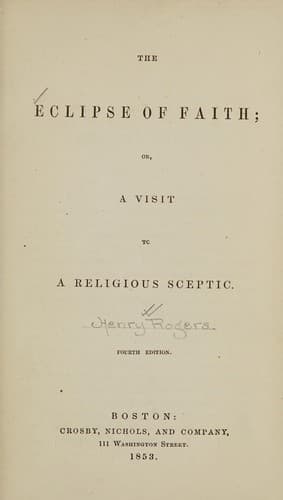
The Eclipse of Faith; Or, A Visit to a Religious ScepticRogers, Henry
Religion
The Eclipse of Faith; Or, A Visit to a Religious Sceptic
Rogers, Henry
Skepticism -- Controversial literature
July 28. I had this morning some curious, and, if it had not been
for the grave importance of the subject, amusing conversation with
Mr. Fellowes on his views, or rather his no views, respecting a
"future life." He said he wished he could make up his mind whether
the doctrine was true; also whether, as some of his favorite writers
supposed, it was of no "spiritual" importance to decide it. I said it
certainly did seem of some importance. I reminded him of Pascal's
saying, that he could excuse men's contented ignorance with any thing
rather than that. "They are not obliged," says he, "to examine the
Copernican system; but it is vital to the whole of existence to
ascertain whether the soul is mortal or not."
"Mr. Newman," said Fellowes, "thinks very differently: but then his
whole mind is differently constituted from Pascal's."
I admitted it, of course.
"Mr. Newman's views," he continued, "on the subject, certainly do not
quite satisfy me; and yet they are very sublime. If he has any hope in
this matter, (of which he appears not absolutely destitute,) it is from
the sheer strength of a 'faith' which triumphs over all obstacles, or
rather hangs upon nothing. He ridicules all intellectual proofs, and
at the same time declares that his 'spiritual insight' deserts him.
It is a faith pure from all reason, and from all 'insight' too. As to
insight in this matter, I must agree with him, that, to ascertain the
fact of a future life by 'direct vision,' is 'to me hitherto impossible.'"
Harrington, who was sitting by, smiled: "You speak of your 'insight' and
'direct vision' much as a Highlander might talk of his 'second sight.'
As to your present difficulty, do you remember the advice of Ranald of
the Mist to Allan M'Aulay, when the 'vision' obstinately averted its face
from him? 'Have you reversed your own plaid,' said Ranald, 'according to
the rule of the experienced seers in such cases?' You do not wear a plaid,
George, but suppose you try the experiment of turning your coat
inside out."
"Really, Harrington," said Fellowes, with becoming solemnity, "'insight'
is far too serious a subject to joke upon."
"Why, my dear fellow," said the other, "you do not think I am going to
treat your 'insight' with more respect than we treat the Bible."
"Odi profanum," said Fellowes, almost angrily.
"No man hateth his own flesh," said Harrington, with provoking quiet;
"and that, I am sure, is from no profane writer. As to the 'odi profanum,'
why, I shall simply say, that
'You can quote it,
With as much truth as he who wrote it.'"
So saying, he left the room. I was not sorry that he was gone, as I
thought perhaps Fellowes might be more communicative. I asked him why
he felt Mr. Newman's arguments on this subject unsatisfactory; why
he could not acquiesce in them.
Public-domain text, read in full here on John Shaqi.
Reviews
Reviews
No reviews yet
Be the first to share your thoughts on this work.
Elsewhere in the archive
Join the Discussion
Join the discussion
Sign in to leave a comment or review.
Sign InorCreate an account