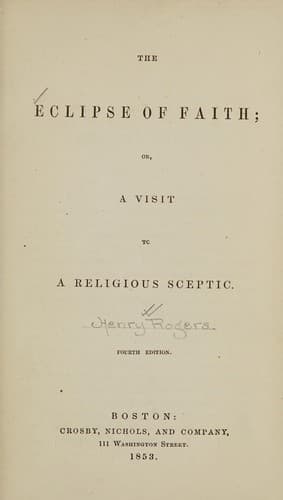
The Eclipse of Faith; Or, A Visit to a Religious ScepticRogers, Henry
Religion
The Eclipse of Faith; Or, A Visit to a Religious Sceptic
Rogers, Henry
Skepticism -- Controversial literature
"In the first place, then," said he, "I was struck with the fact, that,
while admitting that he had no 'spiritual insight' on the subject of a
future life, he yet admits that others may have enjoyed what is impossible
to him; that there may be souls favored with this 'vision,' though clouds
obscure his own. It is true he has admitted (and indeed who can deny it?)
that the spiritual faculty is not equally developed in all men;--though,
as it is not, I feel some difficulty in rejecting the arguments hence
arising for the possibility and utility of an external revelation;--yet
at the best, if the faculty may be so uncertain in reference to so
important a question, when consulted by so diligent and deep a student
of its oracles as Mr. Newman, if even his soul may be dubious on such
a point,--why, upon my soul, I sometimes hardly know what to think.
Again, Mr. Newman says, that some may have, as by special privilege
from God, what is denied to him. Now really this looks a little too
much like favoring the vulgar view of inspiration, nay, a sort of
Calvinistic 'election' in this matter; it seems to me to cast doubts
both on the competency and the uniformity of the sublime 'spiritual
faculty,' even when most sedulously consulted."
"It does look a little like it," said I; "and what next?"
"In the next place, I am free to confess, that, if I may be allowed
to argue against such an authority--"
"O, remember, I pray, that you are of the school of free thought: do
not Bibliolatrize."
"To state my views freely then: I must say, that, if this suspected
doctrine be not one of the unsophisticated utterances of the spiritual
nature of man, I am almost led to doubt whether the clearness with
which the spiritualist 'gazes' on the rest may not possibly be an
illusion. For if any truth would seem to be a dictate of nature, it is
a sort of dim conviction or impression of a future state. We see it,
in some shape or other, extensively believed by all nations, and forming
a feature of all systems of religion, however degraded they may be.
Mr. W. J. Fox mentions it as one of those things which are certainly
characteristic of the absolute religion; so does Mr. Parker. Mr. Fox
expressly affirms that the approximate universality of the belief
justifies the application of his criterion for detecting the eternally
'true' under the Protean shapes of the 'false' in religion; it is one
of the points, he says, in which they are all agreed."
Public-domain text, read in full here on John Shaqi.
Reviews
Reviews
No reviews yet
Be the first to share your thoughts on this work.
Elsewhere in the archive
Join the Discussion
Join the discussion
Sign in to leave a comment or review.
Sign InorCreate an account