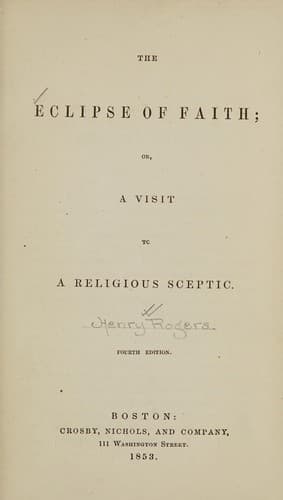
The Eclipse of Faith; Or, A Visit to a Religious ScepticRogers, Henry
Religion
The Eclipse of Faith; Or, A Visit to a Religious Sceptic
Rogers, Henry
Skepticism -- Controversial literature
"I answer, that Mr. Newman too often speaks as if his individual
impressions were to be taken for demonstration. That the Old Testament
is unpervaded by any distinct traces of expectations of a future life is,
at all events, not the opinion of the majority of men, many of them at
least as capable of judging as Mr. Newman. It is not the opinion of
the writers of the New Testament, that the Old Testament worthies were
in this deplorable darkness; nor of the majority of the Jewish
interpreters of their ancestors' writings; nor is it the impression of
the great majority of those who now read them. How it can be the opinion
of any one who has not some hypothesis to serve, is to me a mystery.
Meanwhile Mr. Newman himself at least gives some notable passages to
the contrary, though he chooses to call them only personal aspirations.
Think of the absurdity, my good friend, of supposing that Job, David,
Isaiah, failed to realize a doctrine (imperfectly it may be) which, as
you truly affirm, has, in some shape or other, animated all forms of
religion! that these brightest specimens of 'spiritual religion' in
the ancient world somehow missed what many of the lowest savages have
managed to stumble upon!"
"Well," he replied, "but, after all, he who loves God without any
thought of heaven must surely be more unselfish than he who hopes
for it."
I laughed,--for I could not help it.
"Unhappy Paul!" interjected Harrington, who had again entered the
library; "unhappy Paul! Burdened with the hopes of immortality; what an
impediment he must have found it in his Christian course! I wonder he
did not throw aside 'this weight, which so easily beset him.' Pity
that when he became a Christian, and ceased to be a Pharisee, he did
not, like so many 'spiritual' Christians of our day, know that, when
he became a Christian, he might still remain in one of the Jewish
sects, and turn Sadducee."
"Be it so," said Fellowes, "a Christian Sadducee, caeteris partibus,
might perhaps be a more virtuous man having no hopes of heaven by
which he can possibly be bribed."
Public-domain text, read in full here on John Shaqi.
Reviews
Reviews
No reviews yet
Be the first to share your thoughts on this work.
Elsewhere in the archive
Join the Discussion
Join the discussion
Sign in to leave a comment or review.
Sign InorCreate an account