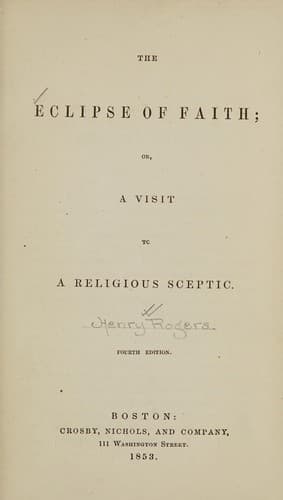
The Eclipse of Faith; Or, A Visit to a Religious ScepticRogers, Henry
Religion
The Eclipse of Faith; Or, A Visit to a Religious Sceptic
Rogers, Henry
Skepticism -- Controversial literature
"Why," replied I, laughing; "I cannot conceive how the hope of a
virtuous immortality can produce a vicious self-love. But if the
hope and the consciousness of happiness now exercise any influence
at all, your argument proves too much; and there is a simple
impossibility of being unselfishly religious at all."
"How so?"
"Do you think that, admitting not only the uncertainty of any future
life, but the certainty that there is none, and that nevertheless
(as you affirm) man, under that conviction, is just as capable of
manifesting a true devotion and piety towards God, any felicity flows
from his so doing?"
"The highest, of course," said he.
"Do you think that the happiness so derived and expected from day to
day has any sinister influence on the spiritual life of him who
feels it?"
"Of course, none."
"The contrary, perhaps?"
"I think so."
"Then neither need the expectation of an eternity of such blessedness
be any impediment. Again; let us come to facts; are not the declarations
of those whom Mr. Newman, however oddly, is willing to admit have been
the best specimens yet afforded of his true 'spiritual' man,--the
Doddridges, the Fletchers, the Baxters, and Paul especially,--full of
this sentiment? 'I desire to depart,' says Paul, 'and to be with Christ,
which is far better'; and similar selfish hopes inspired those excellent
men whose names still rise spontaneously to Mr. Newman's memory when
he would remind us of examples of his 'spiritual religion! Tell me, do
you not think Paul a 'spiritual' man?"
"Yes; with all his blunders," said Fellowes, "I do; and Mr. Newman's
writings are full of that admission."
"Very true. But then Paul is so selfish, you know, as to say, not merely
that the immortality of man is true, and that the 'light afflictions
which are but for a moment' are to be despised, because unworthy 'to be
compared with the glory to be revealed'; but that, if immortality be not
true, Christians, as deluded in such hopes, are of all men most miserable.
All this shows how powerfully the 'spiritual' Paul thought that the
doctrine of a future state operated and ought to operate on the mind of
a Christian; he never supposed that it could possibly have a negative,
still less a sinister influence.'
"But then, surely, what Mr. Newman says is true, that many of the saints
of the Old Testament exemplified all the heroism of a true faith, and
kindled with the ardors of a true devotion, in an ignorance of any such
state, and the absence of all such expectations."
Public-domain text, read in full here on John Shaqi.
Reviews
Reviews
No reviews yet
Be the first to share your thoughts on this work.
Elsewhere in the archive
Join the Discussion
Join the discussion
Sign in to leave a comment or review.
Sign InorCreate an account