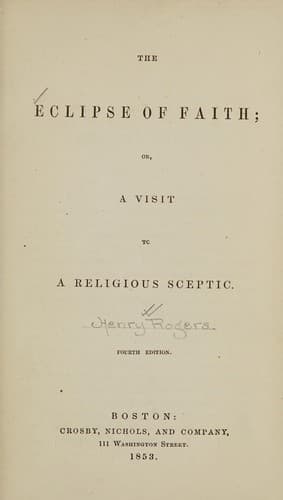
The Eclipse of Faith; Or, A Visit to a Religious ScepticRogers, Henry
Religion
The Eclipse of Faith; Or, A Visit to a Religious Sceptic
Rogers, Henry
Skepticism -- Controversial literature
"It has not escaped me,--I remember it well; but it seems to have
escaped you, that it is a very transparent sophism. For what is it
but a pretence that the Christian in general is confident enough of
his virtue to think that he has not been sufficiently well treated,
and that his Creator and Judge cannot do less than make amends for
his injustice, by giving him compensation in another world?"
"And is not that the true statement of the case?"
"I imagine not; whether men be Christians or otherwise. The generality,
when they reason upon this subject, (you and I, for example, at this
very moment,) not at all considering the aspect of such a day upon
themselves; how much they will lose if there be none; perhaps the
bulk would wish that it could be proved that it would never come! It
has been from a wish to escape great speculative perplexities, connected
with the divine administration, and not in relation to man's deserts,
that the question has been argued. When dictated by other feelings,
the conviction of a future state has been quite as generally the
utterance of remorse and fear, the response of an accusing conscience,
as of hope and aspiration; and derives, perhaps, a terrible significance
from that circumstance. But it has certainly not been, in the Christian,
the result of any absurd expectation of virtues to be rewarded, or rights
to be redressed. As to the Christian, though he feels that he would not,
and dare not, go to the divine tribunal with any such absurd plea as
Mr. Newman is pleased to put into his mouth,--though he cannot impeach
the divine goodness,--he none the less feels that that goodness, if
this scene be all, is open to very grievous impeachment in relation to
millions who have suffered much, and done no wrong, and to multitudes
more who have inflicted infinite wrong, and suffered next to nothing;
and they would fain, if they could, get over difficulties which
Mr. Newman chooses, from the mere exigencies of his theology, to
represent as no difficulties at all. To escape them or to solve them is
the thing principally in the minds of those who contend for a day
of recompense; not the imaginary compensation of individual wrongs. I do
contend that, if this world be all, the divine administration in many
points is more hopelessly opposed to our moral instincts, and to all
our notions of equity and benevolence, than any thing on which you
spiritualists are accustomed to justify your censure of Scripture.
You ought, as Harrington says, to go further."
____
Public-domain text, read in full here on John Shaqi.
Reviews
Reviews
No reviews yet
Be the first to share your thoughts on this work.
Elsewhere in the archive
Join the Discussion
Join the discussion
Sign in to leave a comment or review.
Sign InorCreate an account